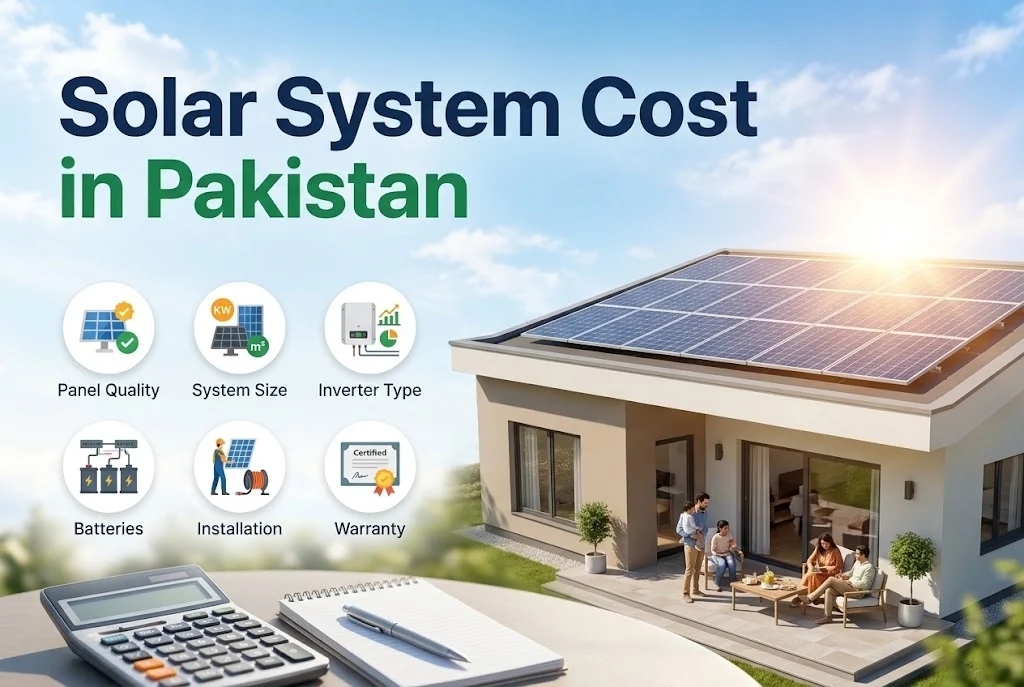
“How much does a solar system cost?” is the first question almost every customer asks, and the honest answer is that it depends on the system. Two quotations for “5 kW solar” can differ widely because they may describe very different systems. This guide explains what actually decides the price, so you can compare quotations on equal terms instead of comparing a single number.
We do not publish a price list here, because prices move with equipment markets, exchange rates and the details of each site. What we can do is show you where the money goes and what to ask for.
Key takeaways
- The biggest drivers are system size, system type (on-grid, hybrid or off-grid) and the brands and models of panels, inverter and batteries.
- Batteries and hybrid inverters add the most cost, which is why a system with backup costs more than a grid-tied one of the same size.
- Mounting structure, cables, protection devices, earthing and installation work are real costs and are often left out of the cheapest quotations.
- Compare itemised quotations with brand, model, capacity and warranty written down, not a single total.
1. System size (kW)
Size is the starting point: a larger system needs more panels, a larger inverter, more structure and more cable. The right size comes from your electricity use, your daytime load, the space you have and your goal (cut the bill, keep running during outages, or both). Our guide to calculating the right solar system size shows the method.
2. System type: on-grid, hybrid or off-grid
An on-grid system has no batteries and is the simplest and usually the least expensive per kW. A hybrid system adds batteries and a more capable inverter so chosen loads keep running during a power cut. An off-grid system must be sized for the worst days without any grid support, which makes it the largest in battery and inverter capacity. See on-grid vs hybrid vs off-grid for how to choose.
3. Solar panels
Panel price depends on technology, power class, efficiency and the manufacturer’s warranty. Newer cell technologies can produce more from the same roof area and handle heat better, but cost more per panel. A lower price per watt is not automatically better value if the panel degrades faster or the warranty is weak. Read solar panel types compared before you decide.
4. Inverter
The inverter is the most important electronic component, and its cost depends on capacity, type (string, hybrid, off-grid), the number of MPPT inputs, brand, monitoring and warranty. Hybrid inverters cost more than grid-tied ones because they manage batteries and backup output. More in our solar inverter guide.
5. Batteries
If you want backup, battery type and capacity are a large part of the price. Lithium iron phosphate (LiFePO4) batteries usually cost more up front than lead-acid but usually give more usable energy and more cycles. The right choice depends on how often you will cycle the battery and for how long you need backup; see solar batteries: lithium vs lead-acid.
6. Mounting structure
Structures differ in material (galvanised steel or aluminium), thickness, height, tilt and the type of roof or ground they stand on. A structure that must resist wind, carry the panels for many years and avoid damaging the roof is a significant cost, and it is the first place a very cheap quotation saves money.
7. Cables, protection and earthing
DC and AC cables, connectors, breakers, isolators, surge protection and earthing are what make an installation safe. Undersized cable or missing protection may not show up on day one, but it shows up as losses, faults or danger later. Ask exactly what is included.
8. Installation, civil work and logistics
Labour, lifting equipment, roof preparation, trenching, transport and site access all affect the price. A flat concrete roof near the road is cheaper to build on than a tall building with a difficult access route or a ground-mount site that needs foundations.
9. Monitoring, documents and approvals
Monitoring, commissioning, documentation and any paperwork for connecting to the grid (see net metering in Pakistan) take time and have a cost, even when they are handled for you.
10. Equipment prices, exchange rates and after-sales support
Most solar equipment is imported, so prices follow international markets, exchange rates and any changes in duties. A quotation is only valid for a limited time for this reason. After-sales support, spares and warranty handling are part of what you pay for, and are worth more than a small saving on day one.
How to compare solar quotations
- Ask for an itemised quotation: panels, inverter, batteries, structure, cables, protection, installation and monitoring listed separately.
- Check brands and models: the actual model number of the panel, inverter and battery, not just “branded” or “tier-1”.
- Compare like with like: the same system type, the same kW of panels (DC) and the same inverter capacity (AC).
- Read the warranties: product warranty and performance warranty for panels, inverter warranty, battery warranty and who handles claims.
- Look at what is included: structure material and design, earthing, lightning protection, cabling and civil work.
- Ask about the site visit: a quotation without anyone seeing the roof or the load is a guess.
- Check payment terms and timeline: what is paid when, and when the system will be commissioned.
Estimating payback
Payback is simply the system cost divided by the yearly saving on your electricity bill. The saving depends on how many units the system produces, what those units would otherwise have cost you, and how much of the output you use yourself. Because tariffs and rules can change, treat any payback figure as an estimate and recalculate it when you receive a quotation.
Get a quotation for your site
Send us your recent electricity bills, a few photographs of the roof or site and what you want from the system, and we will recommend a size and system type and send an itemised quotation. Use the quotation form, or call us on 0300-9423441. You can also browse our solar solutions and the products we supply.
Leave a comment