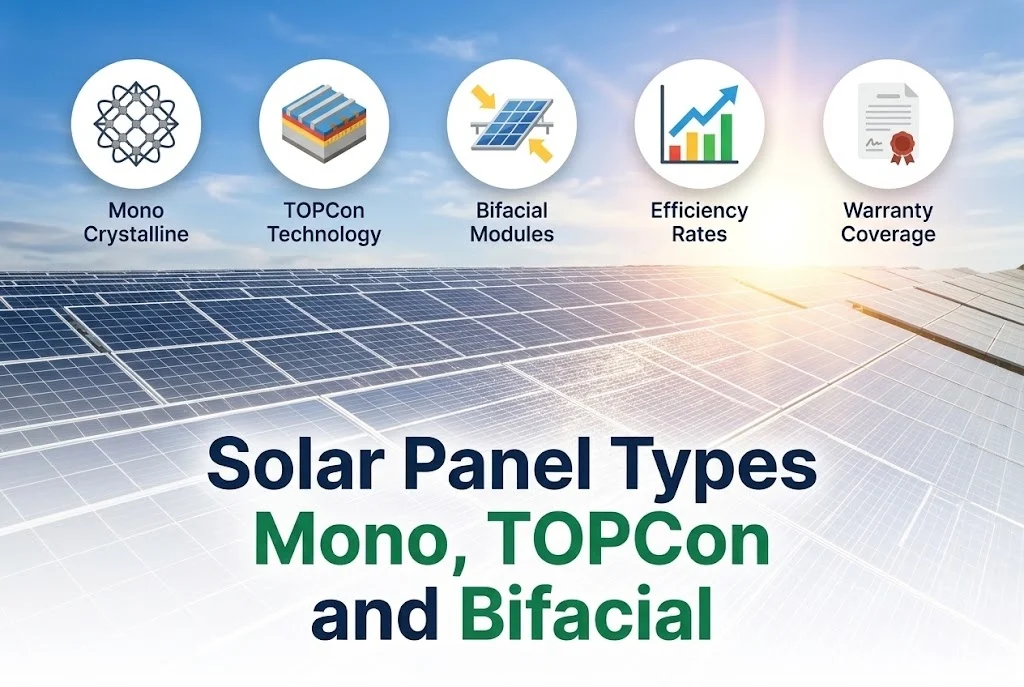
Walk into any solar shop today and you will hear a list of terms: monocrystalline, PERC, TOPCon, N-type, bifacial, half-cut. They describe how the cells inside a panel are built, and they affect how much power a panel produces, how it behaves in heat and how long it lasts. This guide explains the main panel types in plain language and shows which datasheet figures to compare.
Key takeaways
- Most panels sold today use monocrystalline cells; polycrystalline panels have become uncommon.
- N-type technologies such as TOPCon generally offer higher efficiency, a lower temperature coefficient and lower degradation than older P-type PERC panels, usually at a somewhat higher price.
- Bifacial panels add output from the rear side, but the gain depends on the ground or roof surface and the installation height.
- Read the datasheet: power class, efficiency, temperature coefficient, degradation and warranty tell you more than the brand name alone.
Monocrystalline panels
Monocrystalline cells are cut from a single crystal of silicon, which gives them higher efficiency than older types and a uniform dark appearance. Almost all current panels are monocrystalline in one of the variants below.
PERC (P-type mono)
PERC (passivated emitter and rear cell) added a layer at the back of the cell that improved efficiency, and it became the standard for several years. PERC panels are widely available and are often the lowest-cost mono option. Their temperature coefficient and long-term degradation are generally somewhat less favourable than the newer N-type cells.
TOPCon (N-type mono)
TOPCon (tunnel oxide passivated contact) cells use N-type silicon and an extra passivating layer. In general they offer higher efficiency, lower first-year and annual degradation and a lower power loss in heat compared with PERC. Many manufacturers now make TOPCon panels in large formats with power ratings of 550 W and above.
HJT (heterojunction)
HJT cells combine crystalline silicon with thin silicon layers and are known for very good performance in high temperatures. They are less common and tend to cost more.
Polycrystalline panels
Polycrystalline panels are made from multiple silicon crystals, which makes them cheaper to produce but less efficient. They need more area for the same power and have become rare as mono prices fell. If you are offered polycrystalline panels, compare the price per watt and the area needed carefully.
Half-cut cells and large formats
Many modern panels use half-cut cells, which reduces resistive losses and can improve behaviour under partial shade, and large formats of more than 2 metres in length. Larger and heavier panels are harder to handle on a roof; ask your installer about the structure and the wind loading.
Bifacial panels
Bifacial panels can generate power from sunlight reflected onto their rear face as well as the front. The extra output depends on how reflective the surface below is (a white membrane roof or light-coloured ground reflects more than dark or dusty surfaces), on the height and tilt of the panels, and on how much space there is for light to reach the rear. They suit ground-mounted plants and raised structures on light-coloured roofs better than panels laid flat on a dark roof.
Datasheet figures that matter
| Figure | What it tells you |
|---|---|
| Power class (W) | The rated output under standard test conditions. Compare price per watt and the area needed. |
| Efficiency (%) | The share of sunlight turned into power; higher means more power per square metre. |
| Temperature coefficient of power (%/°C) | How much output drops for each degree above 25 °C. Closer to zero is better in hot weather. |
| Degradation | The expected loss of output in the first year and per year after. Lower is better. |
| Product warranty (years) | Cover for defects in materials and workmanship. |
| Performance warranty | The output the maker guarantees after a number of years. |
| Certifications | For example IEC 61215 and IEC 61730 test reports for design qualification and safety. |
Why temperature matters in Pakistan
Panel ratings are measured at a cell temperature of 25 °C, but on a roof in summer the cells can be far hotter. A panel with a lower temperature coefficient loses less power in the heat, which matters in the long summer. Dust and smog also reduce output, which makes regular cleaning important; see our solar panel maintenance checklist.
“Tier-1” and brand names
“Tier-1” comes from a bankability ranking used by lenders and is sometimes used in sales talk as if it were a quality certificate. It is not. Ask for the exact model, the datasheet and the warranty terms, and ask who will handle a warranty claim in Pakistan.
Which type should you choose?
- Limited roof area: higher-efficiency N-type panels give more power from the same space.
- Tight budget and plenty of space: PERC panels can be the lowest-cost route.
- Ground-mount or raised structure on a light surface: consider bifacial panels.
- Hot location: compare temperature coefficients and degradation figures.
Whichever you choose, the panels must match the inverter’s voltage and current limits; see our solar inverter guide. To see what we supply, browse our solar panels, and send us your requirements through the quotation form.


Leave a comment