
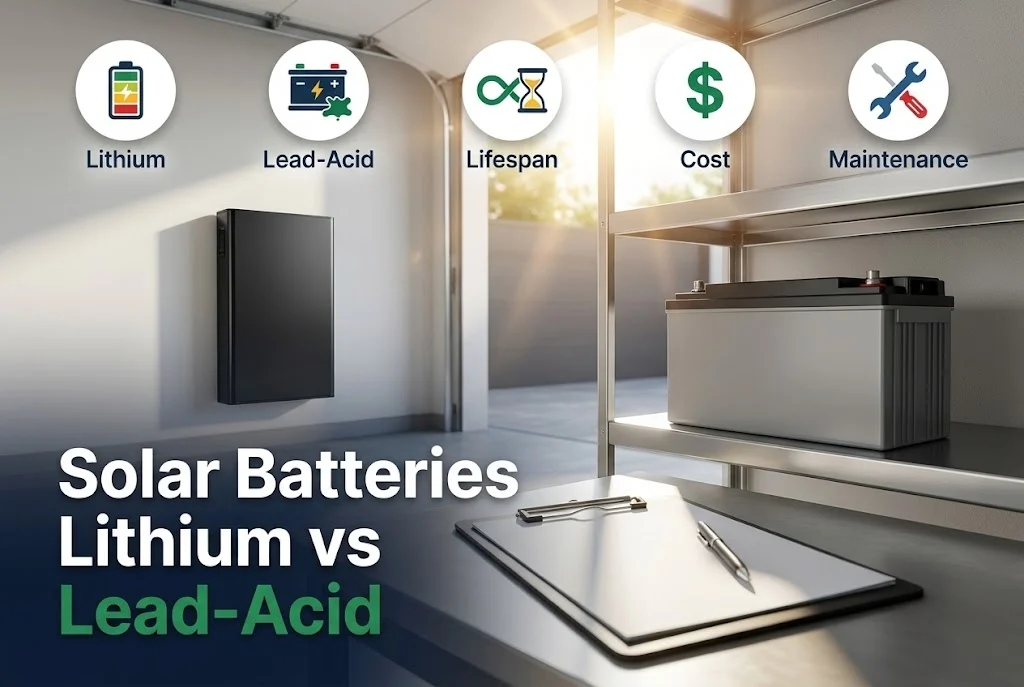
Batteries are what turn a solar system into a backup system, and they are also the part where buyers most often feel confused. Should you buy lithium or lead-acid? How big should the battery bank be? Why do two batteries with the same Ah rating give different amounts of backup? This guide answers these questions in practical terms.
Key takeaways
- Lead-acid batteries (flooded, gel or AGM) cost less up front but give less usable energy, fewer cycles and need more space.
- Lithium iron phosphate (LiFePO4) batteries cost more up front but give more usable energy, more cycles and need little upkeep, so cost per unit of energy delivered over their life is often lower for daily use.
- Battery size depends on your essential load, the hours of backup you want and the usable share of the battery.
- Battery, inverter and charging settings must match.
How batteries are used in a solar system
In a hybrid or off-grid system the batteries store surplus solar energy and supply loads during an outage or at night. Two figures describe a battery: its voltage (for example 12 V, 24 V or 48 V) and its capacity, which is given in ampere-hours (Ah) or, more usefully, in kilowatt-hours (kWh). Energy in kWh is the voltage multiplied by the Ah and divided by 1,000, so a 12 V 200 Ah battery stores about 2.4 kWh in total.
Lead-acid batteries
Flooded (tubular) batteries
Flooded batteries have liquid electrolyte and need periodic topping up with distilled water, ventilation and a place where spills and fumes can be managed. They are the lowest-cost option and a long-standing choice for backup and off-grid use.
Gel and AGM (VRLA) batteries
Valve-regulated lead-acid (VRLA) batteries, using gel or absorbed glass mat (AGM) electrolyte, are sealed and need no topping up. Gel types tolerate regular cycling and heat relatively well, and are widely used in UPS and solar backup. Narada’s MPG 12V 200Ah is an example of a gel VRLA battery; see its specification and discharge data.
Lead-acid in practice
Lead-acid batteries should not be discharged deeply on a regular basis. A common design rule is to use no more than about half of the rated capacity, which is why you need roughly twice the nominal capacity for a given usable energy. They also last longer when kept cool and fully charged.
Lithium iron phosphate (LiFePO4) batteries
LiFePO4 is the lithium chemistry most used in solar storage because of its stability and cycle life. A battery management system (BMS) protects the cells, balances them and communicates with the inverter. Compared with lead-acid, LiFePO4 batteries generally:
- allow a much deeper regular discharge, so more of the rated energy is usable;
- last for many more charge and discharge cycles;
- are lighter and smaller for the same usable energy;
- charge faster and need no maintenance;
- cost more up front.
Quality varies widely between lithium products, so check the cell type, BMS protections, certifications, the warranty and the support available locally. Our brand list includes several battery manufacturers; browse our batteries.
Side-by-side comparison
| Flooded lead-acid | Gel / AGM (VRLA) | LiFePO4 | |
|---|---|---|---|
| Up-front cost | Lowest | Medium | Highest |
| Usable share of rated capacity | About half | About half | Much higher |
| Cycle life | Lowest | Medium | Highest |
| Maintenance | Water topping, cleaning | Little | None |
| Weight and size | Heaviest | Heavy | Lightest |
| Ventilation | Needed | Recommended | Less demanding |
| Best for | Budget backup | Backup and moderate cycling | Daily cycling, limited space |
How to size a battery bank
- List the essential loads in watts and decide how long they must run.
- Multiply the total load (kW) by the hours of backup to get the energy needed (kWh).
- Divide by the usable share of the battery (about 0.5 for lead-acid and a higher figure for LiFePO4) to get the nominal capacity needed.
- Match the voltage of the bank to the inverter (12 V, 24 V or 48 V systems) by connecting batteries in series and parallel.
For the full method, see how to calculate the right solar system size. Add some margin for ageing, since batteries slowly lose capacity.
Temperature, charging and care
Heat shortens battery life, so keep the bank in a cool, shaded, ventilated place. Charging voltage and current limits differ by battery type and manufacturer, and the inverter’s settings must match them; wrong settings are a common cause of early failure. Keep terminals clean and tight, and check the battery’s state of charge and any error messages from time to time.
Which battery should you choose?
- Occasional backup and a limited budget: gel or AGM lead-acid is a common choice.
- Daily cycling for self-consumption or frequent long outages: LiFePO4 is often the better lifetime value.
- Limited space or weight: LiFePO4.
- Remote site without service nearby: a low-maintenance battery with a good warranty.
The battery must also suit the system type; see on-grid vs hybrid vs off-grid and the solar inverter guide. Tell us your essential loads and backup hours through the quotation form and we will recommend a battery bank.


Leave a comment