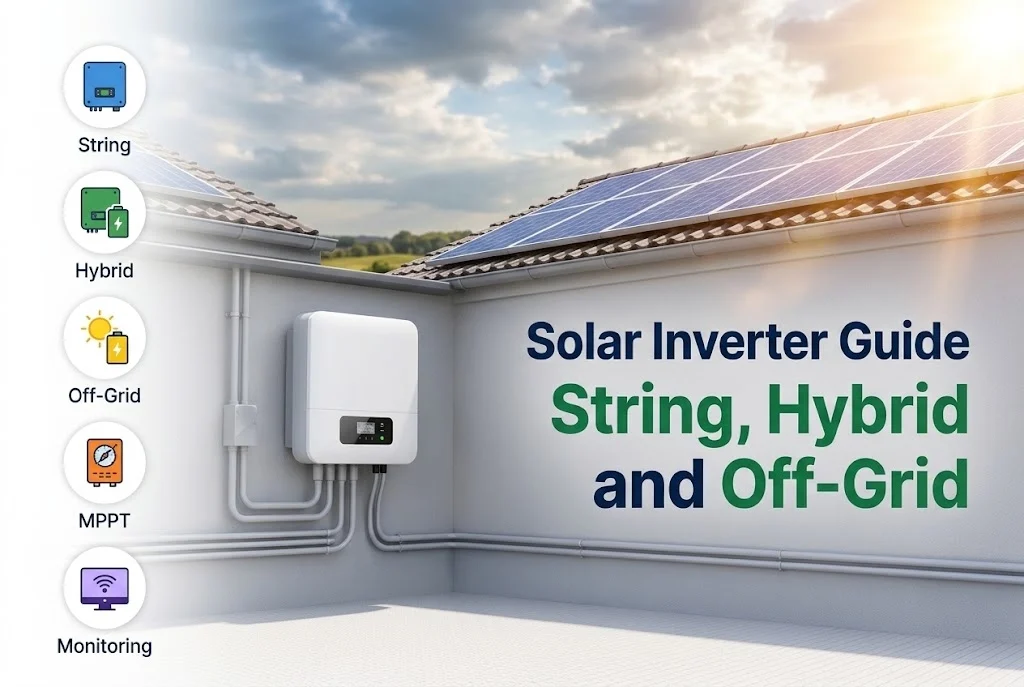
If solar panels are the muscle of a solar system, the inverter is its brain. It converts the DC power from the panels into AC power for your loads, tracks the best operating point of the panels, protects the system and reports what it is doing. A good inverter is also the component most likely to decide whether your system is trouble-free. This guide explains the types and the specifications that matter.
Key takeaways
- Choose the inverter type to match your system: grid-tied (on-grid), hybrid (with batteries) or off-grid.
- Check the MPPT inputs, the DC voltage window and the maximum DC current against your panels before choosing.
- If you run motors, compressors or pumps, check the inverter’s surge capacity as well as its continuous rating.
- Warranty, local service and monitoring are as important as the headline efficiency figure.
What a solar inverter does
- Converts DC power from the panels into AC power at the right voltage and frequency.
- Tracks the maximum power point (MPPT): the best voltage and current of the panels change with sunshine and temperature, and the MPPT function keeps the panels at their best point.
- Protects the system: from over-voltage, over-current, reverse polarity, overheating and, for grid-tied inverters, from grid faults.
- Monitors production and faults, usually through a display and a Wi-Fi or mobile app.
Types of solar inverters
Grid-tied (string) inverters
These work with the grid and have no battery. They are the most common type for homes, offices and factories that want to reduce the bill. Because they follow the grid, they shut down when the grid fails; see on-grid vs hybrid vs off-grid. Single-phase models serve small sites; three-phase models serve larger ones and balance the load across phases.
Hybrid (multi-mode) inverters
Hybrid inverters connect panels, batteries, the grid and a protected output, and decide where power flows. They can keep chosen loads running during an outage. Check which batteries they support (voltage, chemistry and communication), the maximum charge and discharge power, and whether they can also take a generator input.
Off-grid inverters
Off-grid inverters (often with a built-in charge controller) supply loads from batteries and charge the batteries from the panels. They are used where there is no grid, and many also accept a generator or grid input to charge the batteries.
Microinverters and optimisers
Microinverters sit at each panel and optimisers condition the output of each panel. They help where shade or different roof directions are a problem, but cost more and are less common in this market than string inverters.
Central inverters
Very large plants use central inverters or large string inverters with transformers and dedicated switchgear. Their selection is an engineering design task.
Specifications to compare
| Specification | Why it matters |
|---|---|
| AC rated power | The continuous power the inverter delivers; it sets how much load you can run. |
| Maximum DC input power and current | How much panel power the inverter can accept; it limits how many panels you can connect. |
| MPPT inputs and voltage range | More MPPT inputs allow panels facing different directions to work independently; the voltage range must suit your panel strings, including in hot and cold conditions. |
| Efficiency | The share of power that gets through; look at the weighted (European or CEC) figure rather than the peak. |
| Surge (peak) power | The short-term power for starting motors and compressors, which draw several times their running current. |
| Battery voltage and compatibility | For hybrid and off-grid inverters: which batteries it supports and how it communicates with them. |
| Protection rating (IP) | How well the enclosure resists dust and water, important for outdoor installation. |
| Monitoring | Display, app and remote access for production and fault alerts. |
| Warranty and service | The warranty period and who repairs it in Pakistan. |
Sizing the inverter
The inverter’s AC rating is normally close to the size of the panel array, and the array is often somewhat larger than the inverter (a DC to AC ratio of about 1.0 to 1.3), because panels rarely produce their full rated power. A ratio that is too high wastes energy when the inverter clips the output; a ratio that is too low wastes the inverter’s capacity. For backup, the inverter must also be able to supply the combined load and the starting current of motors and compressors. Our guide to calculating the right solar system size covers the method.
Installation and heat
Inverters lose efficiency and may reduce their output when they get hot. Install them in a shaded, ventilated place, away from direct sun and dust, with the clearances the manufacturer specifies. Good cable sizing, correct earthing and surge protection also protect the inverter, and a clean installation makes service easier.
Common mistakes
- Choosing an inverter by price per kW without checking the DC voltage window of your panel strings.
- Ignoring surge power when the site has air conditioners, pumps or workshop machinery.
- Buying a hybrid inverter and batteries separately without checking that they are compatible.
- Installing the inverter in direct sun or a closed, hot space.
Choosing with us
We supply and install grid-tied, hybrid and off-grid inverters. Browse our inverters, see the solar solutions for your type of site, or describe your needs through the quotation form. If an existing inverter is faulty, our repair and maintenance team can look at it; see why a solar system produces less power.


Leave a comment