
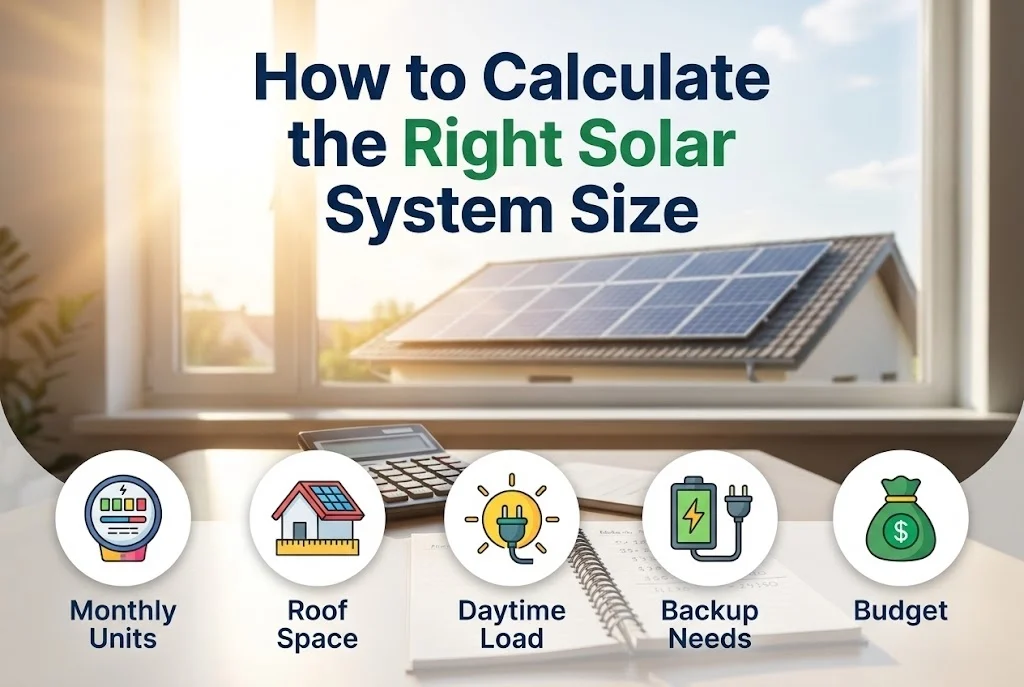
Solar systems are sold in kilowatts, but you buy electricity in units (kWh) and your needs are decided by your bills, your loads and your roof. This guide shows how to turn your electricity bills into a system size you can discuss with an installer. The calculation is simple enough to do yourself, and doing it once helps you judge any quotation you receive.
Key takeaways
- Start from your real electricity use (units per month), not from a rule of thumb.
- A system’s daily output is roughly its size in kW multiplied by the peak sun hours and a performance factor for losses.
- Roof or ground area, the inverter and the batteries must all be checked, not only the number of panels.
- Your goal (cut the bill, cover daytime use, or provide backup) changes the answer.
Step 1: Collect your electricity use
Gather your last 12 months of electricity bills and note the units consumed (kWh) each month. Twelve months matter because summer use with cooling is very different from winter use. Work out the average monthly units, and note the highest month as well.
If you have no bills, such as for a new building, list your appliances with their power in watts and the hours you use each, and add them up. An installer can help with this.
Step 2: Decide what you want the system to do
The target changes the size:
- Offset most of the bill: size the system close to your average yearly use.
- Cover daytime use only: size it to your daytime load, which suits factories and offices that use little at night.
- Provide backup as well: the battery bank and hybrid inverter are sized separately from the panels; see Step 7.
Step 3: Convert monthly units to daily units
Divide the monthly units by 30 to get units per day. A site that uses 600 units in a month uses about 20 units a day.
Step 4: Use peak sun hours and a performance factor
Two numbers connect your daily need to a system size:
- Peak sun hours (PSH): the number of hours per day that sunshine is equivalent to full strength (1,000 W per square metre). In Pakistan it is usually somewhere between about 4 and 6 hours, depending on the city and season. Ask your installer which figure they use for your location.
- Performance ratio (PR): the share of the theoretical output you actually get after losses from heat, dust, cables, the inverter and mismatch. A well-built system commonly operates at a performance ratio of roughly 75% to 85%.
System size (kW) = daily units ÷ (peak sun hours × performance ratio)
Worked example (arithmetic only, not a quotation): a site needs 20 units a day. With 5 peak sun hours and a performance ratio of 0.8, the size is 20 ÷ (5 × 0.8) = 5 kW of panels.
Step 5: Convert kW into a number of panels
Divide the system size in watts by the power of one panel. For 5 kW (5,000 W) with 550 W panels: 5,000 ÷ 550 = 9.1, so 9 or 10 panels. Installers round to fit the inverter’s voltage window and the layout of the roof, so the final count can differ slightly.
Step 6: Check the roof or ground area
Panels need space, and they need to be spaced so they do not shade each other, especially on tilted frames on a flat roof. As a rough guide, allow about 5 to 8 square metres per kW depending on the layout and panel size. Also check:
- Shade from tanks, parapets, trees, neighbouring buildings and stair rooms at different times of day.
- Roof condition and strength, and how the structure will be fixed without damaging waterproofing.
- Orientation and tilt: in Pakistan, panels are normally faced south with a tilt close to the site’s latitude; your installer will advise.
Step 7: Size the inverter and, if needed, the batteries
Inverter: the inverter’s AC rating is usually close to the panel capacity. Panels are often slightly larger than the inverter (a DC to AC ratio of about 1.0 to 1.3), because panels rarely produce their full rated power. If you run motors or compressors, the inverter must also handle their starting currents; see our solar inverter guide.
Batteries: for backup, add up the power of the essential loads and the hours you want them to run.
Battery energy needed (kWh) = backup load (kW) × hours ÷ usable share of the battery
The usable share depends on battery type: lead-acid batteries are normally not discharged below about half, while lithium iron phosphate batteries can usually be discharged much deeper. See solar batteries: lithium vs lead-acid.
Step 8: Add margin for the future, but not too much
If you expect to add air conditioners, an electric vehicle or machinery, tell your installer so the inverter, cables and protection are chosen with room to grow. Oversizing for the sake of it adds cost and may produce power you cannot use or export.
A quick checklist before you request quotations
- Last 12 monthly bills (units).
- The goal: bill reduction, daytime coverage, or backup.
- Roof type and approximate usable area, and photographs.
- Essential loads and the backup hours wanted, if any.
- The sanctioned load of your connection, if you plan to export power; see net metering in Pakistan.
Send these to us through the quotation form and we will propose a system size and send an itemised quotation. To see how price follows size and type, read what decides the cost of a solar system.


Leave a comment