
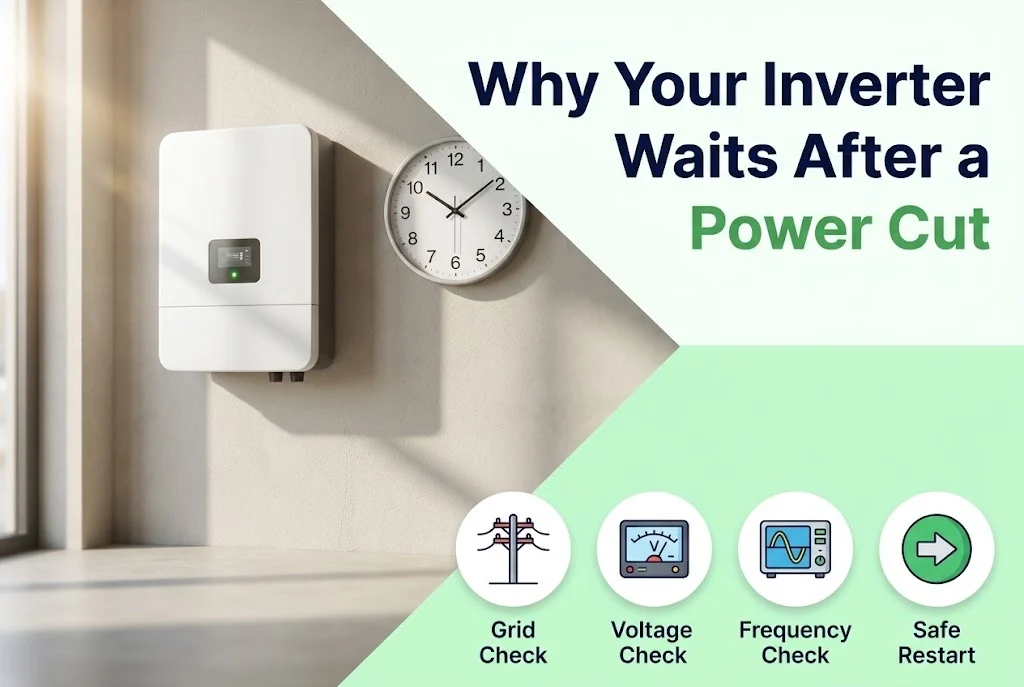
When the grid goes off, your grid-tied solar system stops. When the power comes back, the inverter often waits a few minutes before it starts again. This is by design and it protects people and equipment, but it surprises many owners.
Key takeaways
- A grid-tied inverter must shut down when the grid fails; this is called anti-islanding protection.
- After the grid returns, it checks voltage and frequency for a set period before reconnecting.
- Unstable power can make it trip and wait again and again.
- A hybrid or off-grid system with a battery can keep supplying loads during the outage.
1. Why it shuts down
If a solar inverter kept sending power into a dead grid, it could energise cables that line workers believe are off. To prevent this, grid-tied inverters detect the loss of the grid and stop within a very short time. This is a legal and safety requirement, and it is the reason a plain on-grid system does not run during a power cut.
2. Why it waits afterwards
When the grid returns, its voltage and frequency may still be swinging, and many loads start together. The inverter does not reconnect until it sees stable values for a set period, often from one to several minutes, depending on the settings and the grid code. This is normal, not a fault.
3. When the delay seems too long
If the inverter stays off long after the power returns, check these points:
- The AC breaker and the DC isolator are on.
- The display or app shows a grid or other fault code.
- The grid voltage at your board is within the normal range, and not too high or too low.
- The inverter is not over-temperature.
See solar inverter fault: what to do first.
4. Unstable grids
In some areas, the supply voltage is poor or switches on and off repeatedly. The inverter then disconnects each time, wasting production and wearing the relays. A technician can check the measured grid voltage and, within the allowed grid code, adjust the settings. You should not change the protection settings yourself, since they are set to protect the network.
5. Getting power during an outage
If you need power when the grid fails, you need a hybrid or off-grid system with a battery. See on-grid, hybrid and off-grid solar systems and choosing a hybrid inverter.
Next step
If your inverter takes too long to restart, send us the details through the contact page and we will check the grid values and the settings.
Leave a comment