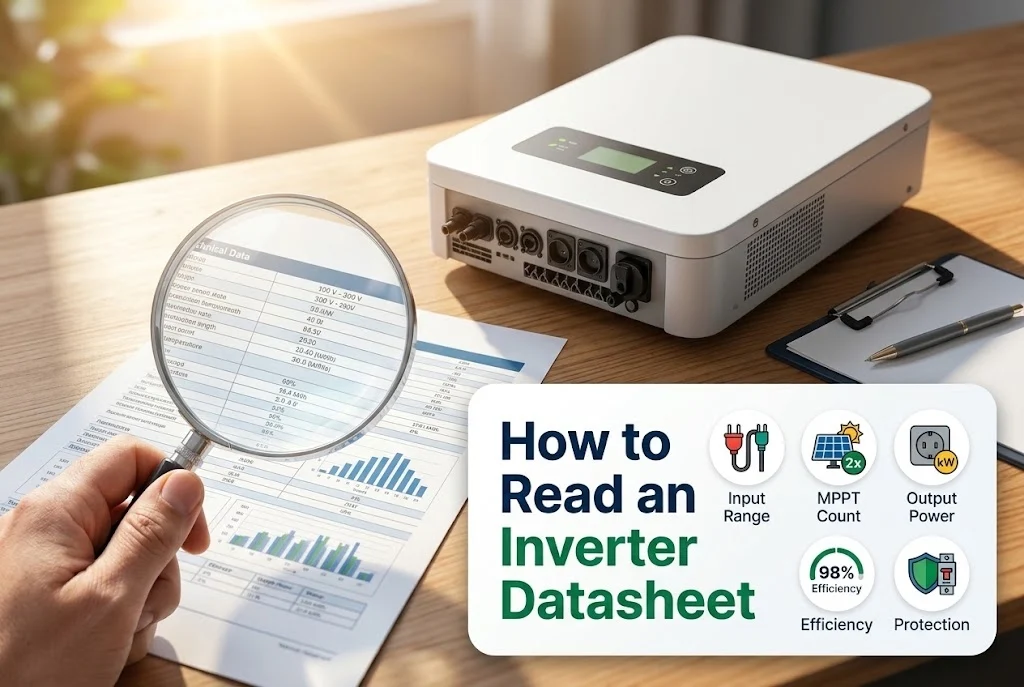
The inverter datasheet is a table of limits, and the design has to stay inside them. If you know the main lines, you can check whether the panels, the cables and the loads are matched to the inverter before you buy.
Key takeaways
- Check the DC input limits: maximum voltage, MPPT range, start voltage and maximum current.
- The AC output tells you what it can supply continuously and the maximum current.
- Efficiency, protection class and operating temperature describe quality and suitability for the site.
- Warranty, certificates and grid-code compliance matter for approvals.
1. DC input
Maximum DC voltage is the highest voltage the inverter can take on its input; the string voltage on the coldest morning must stay below it. MPPT range is the voltage band in which it tracks the best point. Start-up voltage is the minimum to wake up. Maximum input current per MPPT limits how many strings can be put in parallel.
2. Number of MPPTs and strings
Look at how many MPPT inputs there are and how many strings each can take. This decides how flexibly you can arrange panels on different roof faces. See what MPPT is and solar string design basics.
3. AC output
Rated AC power is the continuous power the inverter can supply. Maximum AC current sets the cable and breaker size. Many designs use more panel power than inverter power (a DC to AC ratio above 1), which is fine within the limits given by the maker. Check also the supply type; see single-phase vs three-phase.
4. Efficiency
Peak and weighted efficiency show how little power is lost in the conversion. Most good inverters are above 97 per cent. The difference between models is small, so do not pay much extra for a fraction of a per cent.
5. Protection class and temperature
The ingress protection (IP) rating tells how well it resists dust and water; an outdoor installation needs a suitable rating and some shade. Also look at the operating temperature range and whether output is reduced at high temperature, which is called derating, an important figure for Pakistani summers.
6. Features, certificates and warranty
Check for communication (Wi-Fi or other), monitoring, arc-fault or earth-fault protection, and compliance with the grid standards the electricity company requires. Note the warranty length and whether it can be extended. If any value that matters to you is missing, ask the supplier.
Next step
Ask for the datasheet of the exact inverter model and compare it to the design. We share the datasheet with every quotation; request one through the quotation form.


Leave a comment