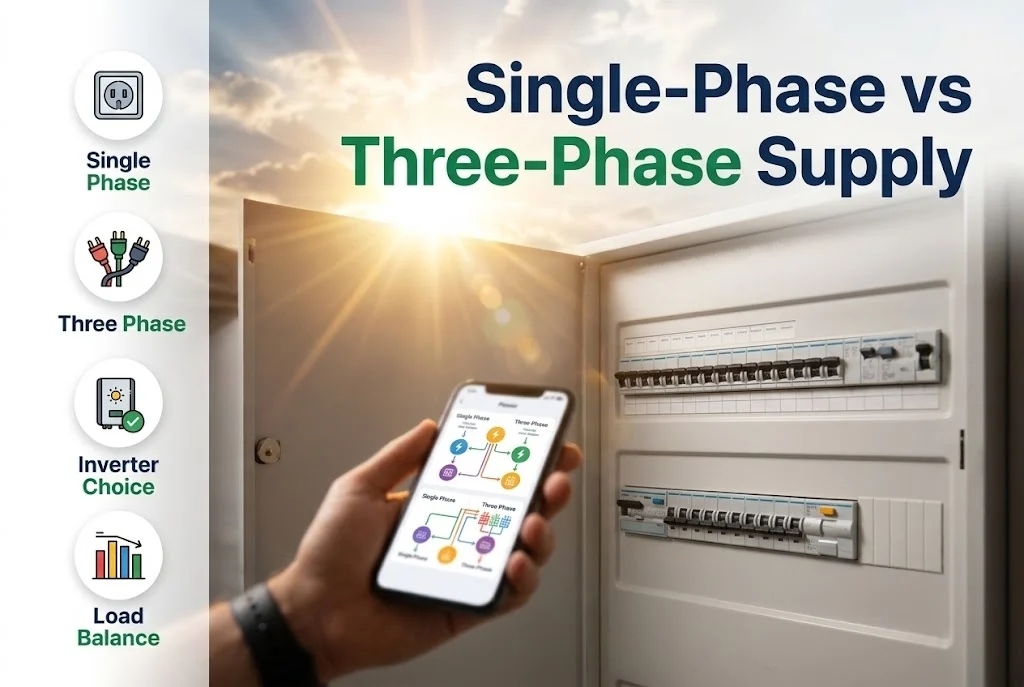
Before choosing an inverter, you need to know what kind of electricity connection you have. Homes usually have single-phase supply, while factories, large shops and big houses often have three-phase. The inverter must match the supply.
Key takeaways
- Single-phase supply is 230 V with one live wire and a neutral; three-phase is 400 V between phases with three live wires and a neutral.
- A single-phase inverter feeds one phase; a three-phase inverter feeds all three evenly.
- Three-phase inverters suit larger loads and keep the phases balanced.
- Check your meter and board, or your bill, to be sure which supply you have.
1. How to tell which you have
Look at the main breaker and the meter. A single-phase connection has a two-pole breaker (live and neutral); a three-phase connection has a four-pole or three-pole breaker with three live cables. Your electricity bill and meter may also state it. If you are unsure, ask your electrician before you ask for quotations.
2. Single-phase inverters
For a normal home, a single-phase inverter of a few kilowatts is common. It connects to the main board and feeds the loads on that phase. For a house with several air conditioners, it is important to check that the total load and the inverter size match, and that heavy loads such as motors start properly.
3. Three-phase inverters
A three-phase inverter produces balanced power on all three phases. This suits larger systems, factories and loads such as three-phase motors and compressors. Many three-phase inverters can also supply three-phase loads from a battery in a hybrid system, but this depends on the model, so check the datasheet. See our solar for factories guide for industrial planning.
4. Phase balance
If a building has three-phase supply but the solar inverter is single-phase, all the solar power goes onto one phase. That can unbalance the phases and may not be allowed by the electricity company. A three-phase inverter, or several single-phase inverters spread over the phases, avoids this.
5. Questions to ask
- Is my connection single-phase or three-phase, and what is the sanctioned load?
- Does the inverter match my supply and my loads?
- In a hybrid system, can the inverter back up three-phase loads, or only some of them?
- Will the electricity company accept this arrangement?
Next step
Send photographs of your meter and main board with a quotation request, and we will confirm the supply type and suggest a suitable inverter through the quotation form.
Leave a comment