
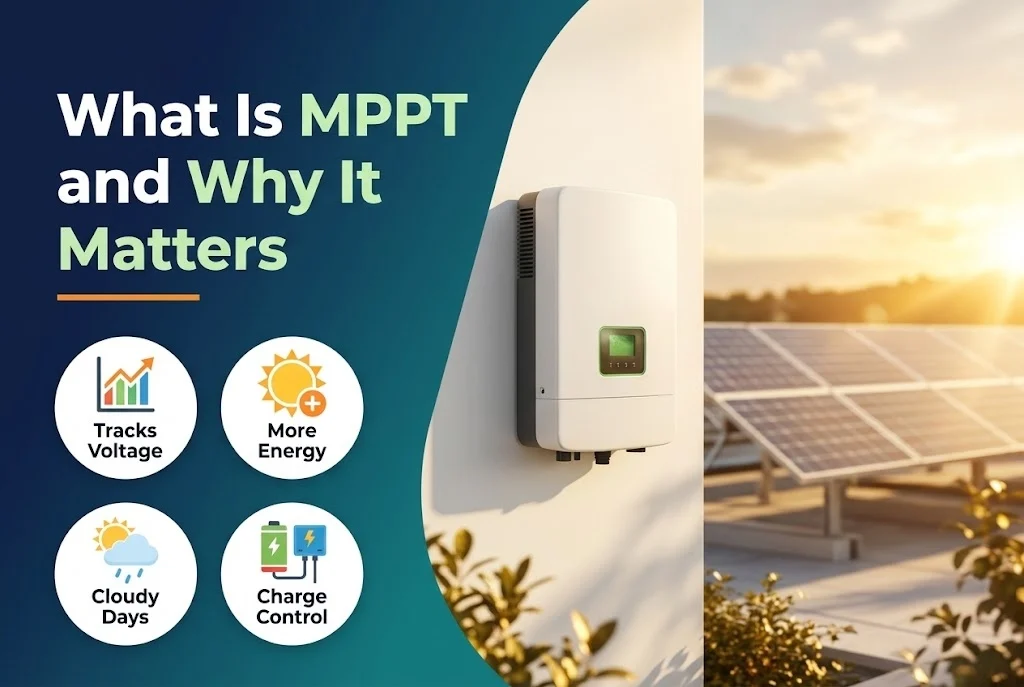
If you read an inverter datasheet you will see "MPPT" many times: number of MPPTs, MPPT voltage range, MPPT current. It sounds technical, but the idea is simple, and understanding it explains why some designs work well and others waste power.
Key takeaways
- MPPT stands for maximum power point tracking: finding the voltage and current at which the panels give the most power.
- The best point moves with light and temperature, so the inverter tracks it all day.
- Each MPPT input handles a group of panels; panels with different orientations or shade should usually be on separate MPPTs.
- The MPPT voltage window is the first thing to check when matching panels to an inverter.
1. The idea in plain words
A solar panel does not have one fixed output. For any light level, the power you get depends on the voltage the panel is made to work at. Too low or too high and the power falls. Somewhere in between is the best point. MPPT is a small control circuit that keeps adjusting the operating voltage to stay at that best point.
2. Why the best point keeps moving
The best point changes with sunlight and with panel temperature. A hot panel gives a lower voltage than a cool one, and a cloud passing over changes the current. Because both change all day, a fixed setting would lose power most of the time. A good MPPT tracker follows the change many times each second.
3. MPPT and PWM controllers
Older and cheaper charge controllers use a simpler method called PWM, which pulls the panel voltage down to the battery voltage. That wastes the extra voltage the panel could have given. An MPPT controller converts it, so you get more usable power, particularly when the panels run at a higher voltage than the battery or when it is cold. For anything but a very small system, MPPT is the usual choice.
4. Several MPPT inputs
Many inverters have two or more MPPT inputs. Each tracks its own group of panels independently. This matters when:
- Panels face two roof directions, for example east and west.
- One part of the array is shaded at certain hours.
- You will add panels later in a different layout.
Putting panels with different conditions on one MPPT forces them to share a single compromise point, and you lose some output.
5. Check the voltage window
Every MPPT has a voltage range in which it works, and a start-up voltage. The string of panels must stay inside that range in cold weather (when voltage is highest) and in hot weather (when it is lowest). Too high and the inverter can be damaged; too low and it stops tracking. This check is part of solar string design, and a good installer does it for you. You can also read how to find these numbers in how to read an inverter datasheet.
Next step
Ask the installer how many MPPT inputs the inverter has, which panels go on each, and what the string voltage will be on the coldest and hottest day. If you would like us to check a design, use the quotation form.

Leave a comment