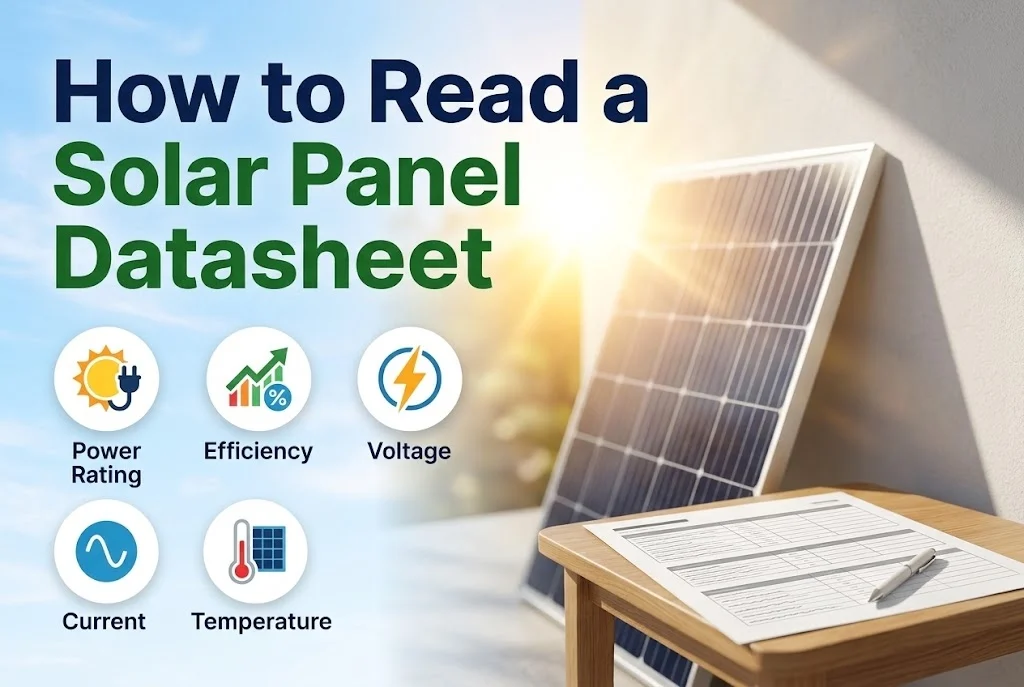
A datasheet is the manufacturer's own statement of what a panel can do. Reading it takes a few minutes and tells you far more than a brand name or a sales talk. Here are the lines to look at, in order.
Key takeaways
- Rated power and efficiency tell you how much power you get from a given area.
- Voltages and currents are needed to design strings correctly.
- The temperature coefficient shows how it behaves in a hot climate.
- Warranty and certificates show what the maker stands behind.
1. Power and tolerance
The rated power (for example 600 W) is measured under standard test conditions. The datasheet also lists the tolerance, such as 0 to +5 W, meaning the panel will not be below its rating. Compare the power class and the physical size together; a higher power in the same size means higher efficiency.
2. Efficiency
Module efficiency is the share of sunlight on the panel that becomes power. A higher efficiency lets you fit more power in limited roof space. It is not the only measure of quality, but if roof space is tight it is important. See solar panel types: mono, TOPCon and bifacial.
3. Electrical figures
The table of Voc, Isc, Vmp and Imp is what the designer uses to build strings. If you do not design the system yourself, check only that the installer has done it. Solar panel watts, volts and amps explained covers what these are.
4. Temperature coefficient and NOCT
The temperature coefficient of power shows how much power the panel loses for each degree above 25 °C. The lower the loss, the better in hot weather. The nominal operating cell temperature (NOCT) shows how hot cells get in typical conditions and the output at that temperature, which is closer to real life than the headline figure.
5. Degradation and warranty
Panels lose a little power each year. The datasheet or warranty document gives a guaranteed output at year one and at the end of the period, such as 25 or 30 years. There are two warranties: the product warranty for defects and workmanship, and the performance warranty for output. Read solar panel warranty explained.
6. Certificates and limits
Look for international test standards, a maximum system voltage and a maximum series fuse rating, which the design must respect. A datasheet that is missing basic figures, or that does not match the model on the quotation, is a warning sign.
Next step
Ask the installer for the datasheet of the exact panel model before you pay. We give datasheets with every quotation; request one through the quotation form.


Leave a comment