
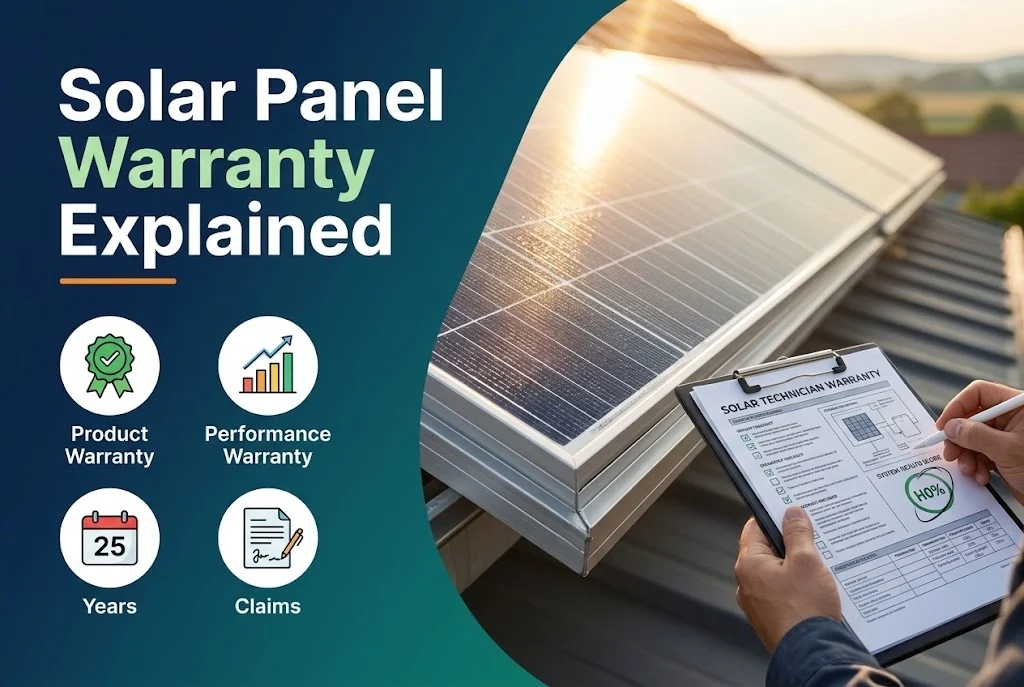
Most panels come with a long warranty, often 25 years or more on paper. A warranty is only as good as the company behind it and the conditions attached, so it pays to read it before you buy, not when you need it.
Key takeaways
- There are usually two warranties: product (defects and workmanship) and performance (output over time).
- Check the length, the conditions and the process for claims.
- Ask who handles a claim locally and who pays for removal, shipping and re-installation.
- Keep the invoice, the serial numbers and the commissioning record.
1. The product warranty
The product warranty covers defects in materials and workmanship, such as cracked glass from a fault, a failed junction box or delamination. It is shorter than the performance warranty, often ten to fifteen years or more, depending on the maker. Read what is excluded, such as damage by storms, unsuitable installation or cleaning with wrong tools.
2. The performance warranty
The performance warranty guarantees that the panel will still produce a stated share of its rated power after a number of years. It usually has a first-year loss and then a steady yearly loss, so the guaranteed output at year 25 or 30 is a figure in the datasheet. The panel does not lose that much every year; it is a minimum, not a forecast.
3. Conditions that can void it
Warranties usually require installation by a qualified person, following the maker's manual, with the right mounting points and clamps. Using an unsuitable cleaning method, modifying the panel, or storing it badly can void a claim. Keep the record of how the system was installed.
4. Who really honours it
A manufacturer in another country may be hard to reach. Ask whether the maker has a local office or distributor, and whether the installer will handle claims. A warranty from a company that may not exist in ten years has little value. Ask also who pays for taking down and re-fitting a panel if a claim is accepted, which can be a large part of the cost.
5. Keep the records
Keep the invoice, the model and serial numbers of the panels, the datasheet, the warranty document, and the commissioning and test report. If a claim is needed later, proof of purchase and of correct installation will be required. See solar commissioning and handover checklist.
Next step
Before you buy, ask for the warranty documents of the exact model and of the inverter. If you would like ours, request them through the quotation form.

Leave a comment