
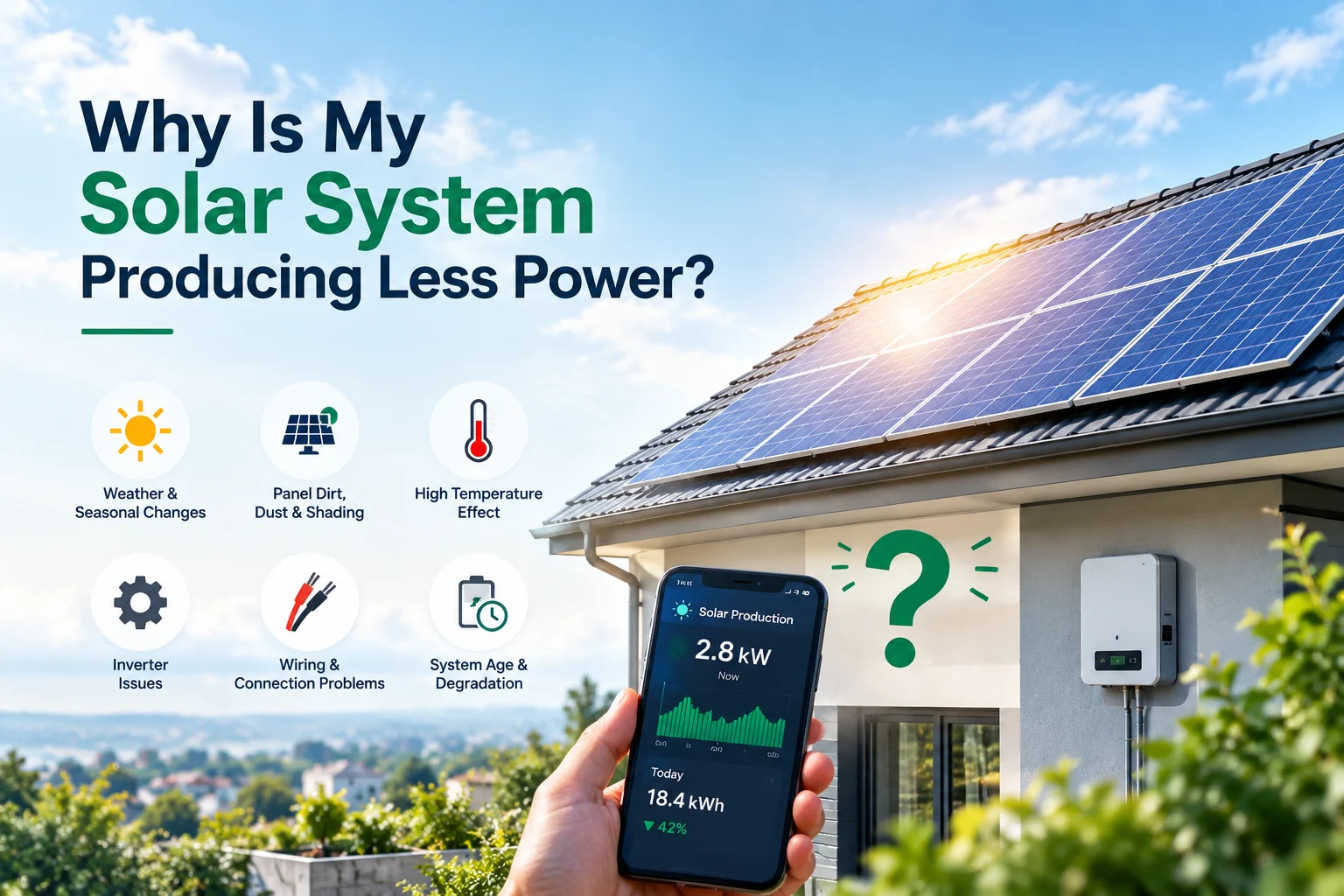
You installed solar panels, and now the output looks lower than you expected, or lower than it used to be. Before you worry, remember that solar output naturally changes with the weather and the seasons. But a real, lasting drop often has a cause you can find and fix. This guide lists the common reasons, roughly in the order you should check them.
Key takeaways
- Compare like with like: clear days against clear days, and the same time of year.
- The most common causes are dirt, shade, heat and the inverter limiting output.
- Genuine faults, such as loose connectors, damaged cables or failed panels, need a technician.
- Monitoring data makes diagnosis much easier.
1. Normal variation: weather and season
Output depends on the sunshine. Clouds, haze and smog reduce it, and the sun is lower in winter, so a system produces fewer units in December than in May even if it is working perfectly. Daily output also varies, so look at weekly or monthly totals before drawing conclusions, and compare with a similar period.
2. Dust, dirt and bird droppings
Dirt blocks light and can reduce production noticeably, especially in dry, dusty or smoggy weather and near construction. Cleaning is the cheapest fix; see our solar panel cleaning and maintenance checklist for how to do it safely.
3. Shade
Even a small shadow on part of an array can reduce output more than its size suggests, because panels in a string work together. New sources of shade include growing trees, a new building next door, water tanks, antennas, parapets and even a wire or a bird’s nest. Check the panels at different times of day.
4. Heat
Panels produce less power as they get hotter, and the loss is larger in long summers. The effect is built into the panel’s temperature coefficient (see solar panel types compared). Good airflow behind the panels helps, and the figure is the reason a hot, sunny day does not always give the highest output.
5. Inverter limits and settings
- Clipping: if the panels can produce more than the inverter’s rating, the inverter limits the output at peak times. This is normal in moderate amounts.
- Over-temperature derating: a hot inverter reduces its output to protect itself; check that it is shaded and ventilated.
- High grid voltage: a grid-tied inverter may reduce or stop output when the grid voltage is above its limit. Frequent voltage trips may need the settings checked.
- Wrong settings: wrong battery charging limits, export limits or time-of-use settings can reduce what you see. See our solar inverter guide.
6. Battery and system mode
On a hybrid or off-grid system, production can look low when the batteries are full and the loads are small, because the inverter has nowhere to send extra power. If your batteries are not charging properly or you see alarms, check the battery state and settings; see solar batteries: lithium vs lead-acid.
7. Loose connections and damaged cables
Loose or corroded connectors, sun-damaged or chewed cables and poor crimps create resistance and heat, which cut output and can be dangerous. Signs include a string producing less than the others, error messages and, in bad cases, burn marks. These need a qualified technician.
8. Faulty or damaged panels
Cracked glass, broken cells, hot spots, delamination or a failed bypass diode can reduce the output of a panel and the whole string. Some damage is visible; some needs thermal imaging or measurement.
9. Mismatch, wrong design or ageing
- Mismatch: panels of different types or orientations in the same string drag each other down.
- Orientation and tilt: panels that face the wrong way or are tilted poorly produce less over the year.
- Undersized cables or too many panels on an input: these cause losses or limiting.
- Ageing: panels lose a small amount of output each year; a steep drop is not ageing.
10. Measurement and expectations
Check the figure you are comparing: some inverters show instantaneous power, some show daily units, and the meter may show a different number from the app. Also check what the system was expected to produce; a 5 kW system does not produce 5 units an hour in all conditions. The method in how to calculate the right solar system size shows how to estimate expected output.
A simple checking routine
- Compare production on a clear day with a similar clear day from earlier.
- Look at the inverter display and the app for error codes or warnings.
- Look at the panels for dirt, shade, damage and anything blocking them; clean if needed.
- Check that the inverter is cool, ventilated and not showing over-temperature.
- If one string or input produces less than the others, note which one.
- If the cause is not clear, or you suspect an electrical fault, switch the system off safely and call a technician.
When to call us
If production has dropped without an obvious reason, the inverter shows repeated faults, or you see damaged panels or cables, contact a technician. We repair and maintain solar and power backup equipment; reach us through the contact page or the quotation form, and see our maintenance services.
Leave a comment