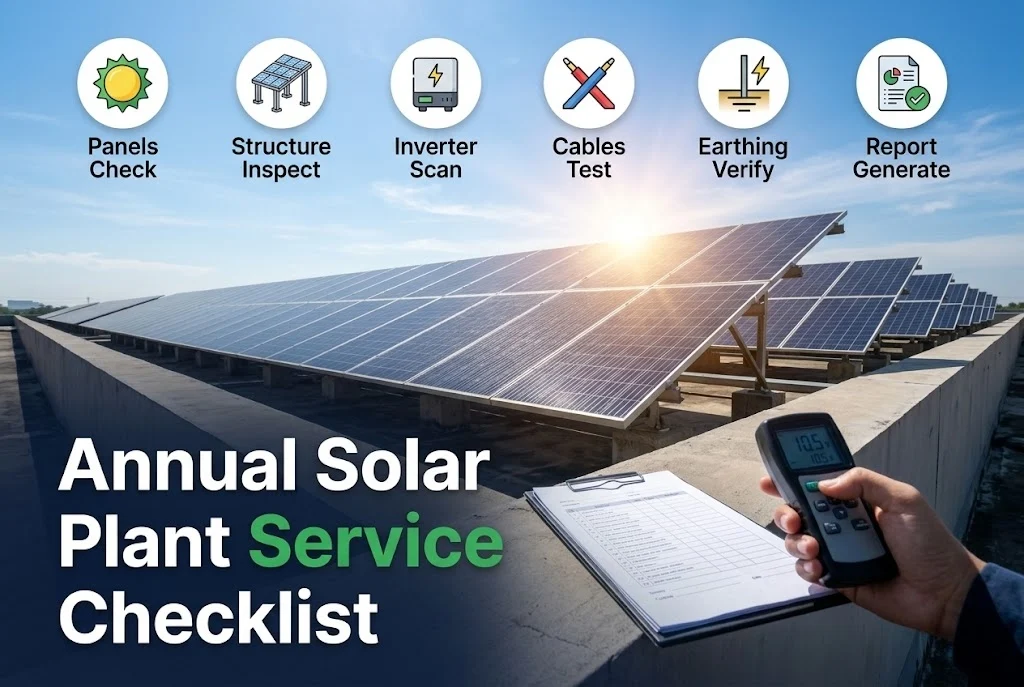
A solar system has no moving parts and needs little attention, but "little" is not "none". A yearly service keeps output up, catches faults early and protects your warranty. This checklist shows what a good service should cover.
Key takeaways
- A service combines a visual inspection, cleaning, electrical checks and a review of the data.
- Work on the roof and on live equipment should be done only by trained people with safety gear.
- Ask for a written report with measurements and photographs.
- A pre-monsoon timing is a sensible choice in Pakistan.
1. Panels and structure
Look for cracks, browning, delamination, hot spots and loose or corroded frames. Check the bolts and clamps and the condition of the roof fixings and waterproofing. Clean the glass using soft brushes and clean water; see solar panel cleaning and maintenance and solar panel hot spots and cracks.
2. Cables and connectors
Check cable routing, ties, conduits and connectors for sun damage, rodent or bird damage, heat marks and looseness. Replace anything damaged.
3. Inverter
Clean dust from vents and filters, check the fan, look at the temperature, and review the event history. Check that the display, communication and the firmware are as they should be. Make sure there is room around the unit for airflow and that it is not in direct sun.
4. Protection and earthing
Operate the isolators and breakers, check the SPD indicators and test the earthing resistance. Record the values. See solar earthing and lightning protection.
5. Electrical measurements
A technician measures the string voltage and current and compares them across strings; low values point to shade, dirt or damage. Insulation resistance tests may be done on the DC side, when the system is shut down safely.
6. Batteries
For a hybrid system, check the battery voltage, the temperature, the connections, the state of charge and any alarms. Lead-acid batteries need more attention than lithium. See temperature and battery life.
7. Data and report
The service should end with a report of what was checked, the measurements, the findings and the recommended actions, with photographs. Compare the year's production with what was expected, as explained in solar monitoring: what to watch.
Next step
We can service your system once or under a yearly plan; see our maintenance service or ask through the contact page.
Leave a comment