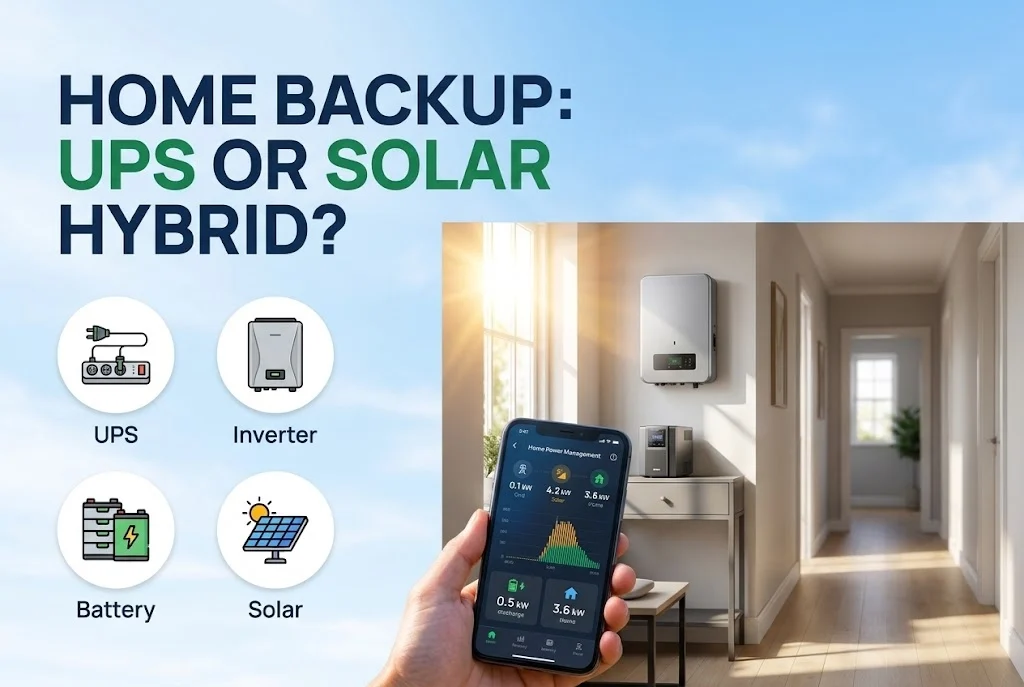
Power cuts push many homes toward backup. The two common choices are a UPS with batteries and a solar hybrid system. They solve related problems in different ways, and the right one depends on what you want to run and for how long.
Key takeaways
- A UPS with batteries gives backup for chosen loads from the grid, and it is relatively simple.
- A hybrid system adds solar panels, so it can recharge the battery, reduce your bill and supply backup.
- Backup time is set by the battery size and the loads, not by the type of system.
- Heavy loads such as air conditioners need a larger design, whichever you choose.
1. What a home UPS or inverter-battery system does
A home UPS or an inverter with batteries charges the battery from the grid and supplies chosen loads such as lights, fans, a router and a television during an outage. It is a simple and lower-cost choice, and it suits homes that mainly need backup. See what a UPS is.
2. What a hybrid system adds
A hybrid system has solar panels and a hybrid inverter. During the day the panels power the home and charge the battery, and the grid fills in. During an outage, the battery and the panels supply the loads. It reduces the grid bill as well as giving backup. See choosing a hybrid inverter.
3. Cost and complexity
A UPS system is cheaper, with fewer parts and a quicker installation. A hybrid system costs more but pays back through savings, and it has more to design, with panels, mounting, protection and approvals. Either needs a proper battery; see how to size a battery bank.
4. What it can run
Lights, fans, a fridge and electronics are easy for both. Air conditioners, water pumps and heaters draw a lot and need a larger inverter and battery. In a hybrid system the panels can carry them by day, which makes it easier; at night the battery must carry them.
5. Who should choose which
- Short, occasional outages and a small budget: a UPS or inverter with batteries.
- High bills and frequent outages: a hybrid solar system.
- Long outages and heavy loads: a hybrid system sized with larger batteries, or add a generator.
Read on-grid, hybrid and off-grid systems for more background.
6. Start with the loads
Whichever you choose, start with a list of the loads you want to keep on and for how long. That list decides everything else.
Next step
Send us your list and your bills and we will suggest a UPS or a hybrid system; use the quotation form or see our residential backup solutions and residential solar.
Leave a comment