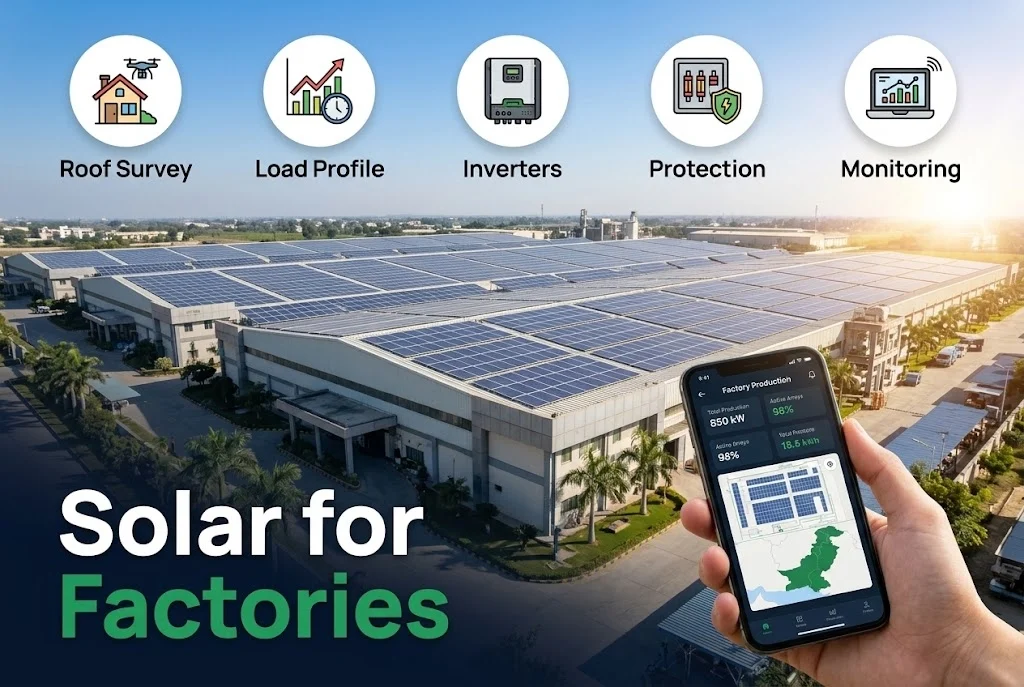
For a factory, mill, cold store or workshop, electricity is a major running cost, and a large flat roof is often unused space. A rooftop solar plant can turn that roof into a source of power, but an industrial system is an engineering project, not a larger version of a home system. This guide sets out how to plan one and the mistakes that most often cost money.
Key takeaways
- Start from the site’s load profile (how much power is used and when), not only from the monthly bill.
- Survey the roof, the electrical room and the grid connection before you design the plant.
- Safety, protection, monitoring and a maintenance plan are part of the design, not extras.
- A written scope, itemised quotation and a clear plan for operation protect your investment.
Why industrial sites suit solar
Many industrial sites use most of their power during daylight, which matches solar production well. Large, flat roofs offer room for big arrays, and a plant that supplies the site’s own load avoids the losses and dependence of buying everything from the grid. Heavy daytime loads such as furnaces, rolling lines, compressors, cold storage and refrigeration, weaving and spinning are typical candidates. Some of the sectors we work with are shown on our projects page.
Step 1: Understand the load profile
Collect the last 12 months of bills and, if possible, interval or demand data for typical days. Note shift timings, the largest loads, when they start and when peak demand occurs. The goal is to see how much of the daytime load a solar plant can supply directly and how it varies by season. Sizing to the bill alone can leave a plant too large for the site’s daytime use or too small to matter.
Step 2: Survey the roof and the site
- Structure: the roof’s type (RCC, steel sheet, asbestos or other), its age, condition and load capacity. Ask a qualified person to confirm that the roof can carry the extra weight and wind load.
- Space and shade: usable area, obstructions, parapets, vents and chimneys, neighbouring buildings and trees that cast shade.
- Access and safety: safe access for installers, lifting routes and fall protection.
- Electrical room: space for inverters and switchgear, cable routes and ventilation.
- Grid connection: the transformer, the main distribution panel and its capacity, and the point of connection.
Step 3: Choose the design
Typical decisions include the number and rating of string inverters, the panel type and mounting angle, whether batteries or a generator interface are needed, and how the plant connects to the site. Panel and inverter choices affect cost and performance; see solar panel types compared and the solar inverter guide. If the site has frequent outages or critical loads, discuss a hybrid arrangement; see on-grid vs hybrid vs off-grid.
Step 4: Plan the protection and safety systems
- Correct cable sizing, UV-resistant DC cable and good connectors.
- Breakers, isolators and surge protection on DC and AC sides.
- Earthing and, where required, lightning protection.
- Clear labelling, safe isolation points and, where fire safety requires it, rapid isolation arrangements.
- A safe cable route and mechanical protection against rodents and damage.
Step 5: Think about grid connection and rules
Check what your distribution company requires for connecting a plant and for exporting any surplus; see net metering in Pakistan. Confirm the rules for your sanctioned load and the equipment approvals needed before design is fixed.
Step 6: Install, commission and test
A good installer will follow a documented installation plan, check the structure and fixings, test the strings and the protection, commission the inverters and record the results. Ask for the as-built drawings, the test records and the warranty documents at handover.
Step 7: Monitor and maintain
Monitoring shows production against expectation and flags faults. A maintenance plan covers cleaning, inspection, thermal checks, torque checks, inverter servicing and response times for faults; see our solar panel maintenance checklist. Without monitoring and maintenance, losses can go unnoticed for months.
Common mistakes in industrial solar
- Sizing from the bill rather than the daytime load.
- Ignoring the condition of the roof and the waterproofing under the structure.
- Using inexpensive structures, cables or connectors that will not last as long as the panels.
- Overlooking shading from tanks, chimneys and other buildings.
- No monitoring and no maintenance plan.
- Forgetting future growth in load or space.
- Leaving the grid and generator interface until the end, when it is hardest to change.
- Choosing on price alone, without comparing the scope, brands and warranties; see what decides the cost of a solar system.
How we can help
We supply, install and maintain solar systems for commercial and industrial sites. See our industrial solar and commercial solar pages, and tell us about your site through the quotation form.

Leave a comment