
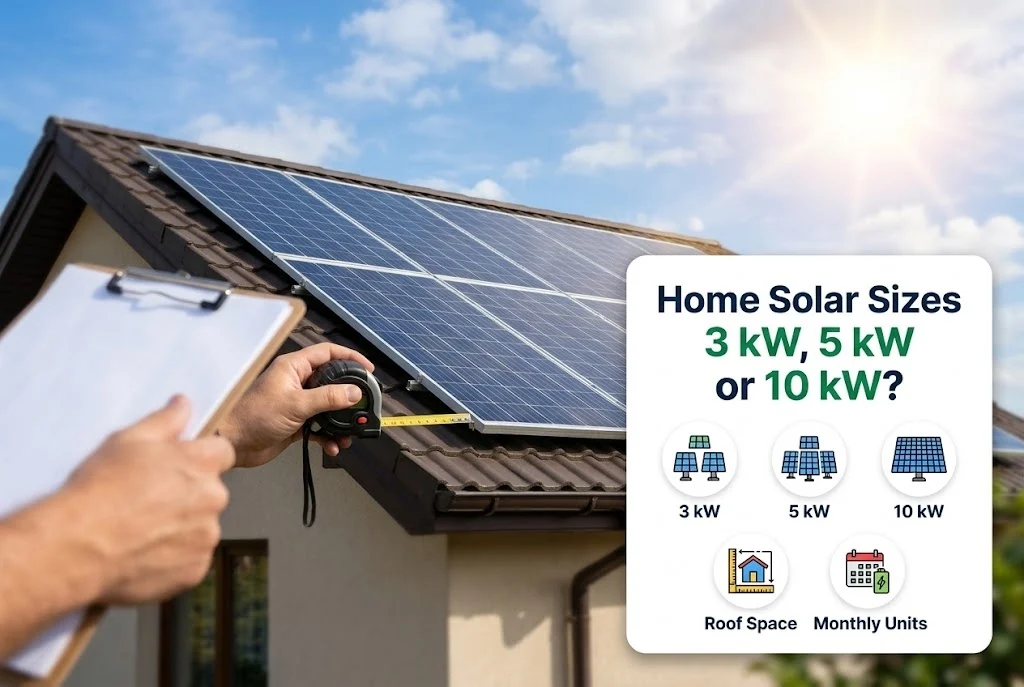
The three sizes most homeowners ask about are 3 kW, 5 kW and 10 kW. Each suits a different home, but the right answer depends on your bills, your air conditioning and your roof, not on the number alone.
Key takeaways
- A rough guide to production is about three and a half to four and a half units per kW per day on average, varying by season and place.
- Size the system from your bills and your roof, not from a fixed rule.
- Check whether you want grid-tied, hybrid or battery backup, which changes the design and the cost.
- A site visit gives a better answer than any guide.
1. How many units each size can make
As a rough average across the year, a good system in Pakistan produces about 3.5 to 4.5 units (kWh) per kilowatt per day, more in spring and less in the foggy winter. That gives:
- 3 kW: roughly 10 to 13 units a day, or around 300 to 400 a month.
- 5 kW: roughly 17 to 22 units a day, or around 500 to 650 a month.
- 10 kW: roughly 35 to 45 units a day, or around 1,000 to 1,300 a month.
These are estimates only; the real figure depends on shade, tilt, dust and the inverter.
2. Which home suits which
A 3 kW system suits a small home with fans, lights, a fridge and one or two air conditioners used lightly. A 5 kW system suits a medium home with several air conditioners and normal appliances. A 10 kW system suits a large home or one with heavy summer use. Always compare with your own bills. See understand your electricity bill before you go solar.
3. Grid-tied, hybrid or off-grid
A grid-tied system lowers your bill but stops in a power cut. A hybrid system with batteries keeps selected loads on during outages, but costs more and the batteries must be sized for the loads. See on-grid, hybrid and off-grid.
4. Roof space
A 10 kW system may need more roof than you have. Read how much roof space a solar system needs and measure before deciding.
5. Plan for growth
If you may add air conditioners, an electric vehicle or a new floor, choose an inverter and a design that allow more panels later. It is cheaper to plan this at the start. For the full method, read how to calculate the right solar system size.
Next step
Send us your bills and a photograph of the roof through the quotation form and we will propose a size and explain why.


Leave a comment