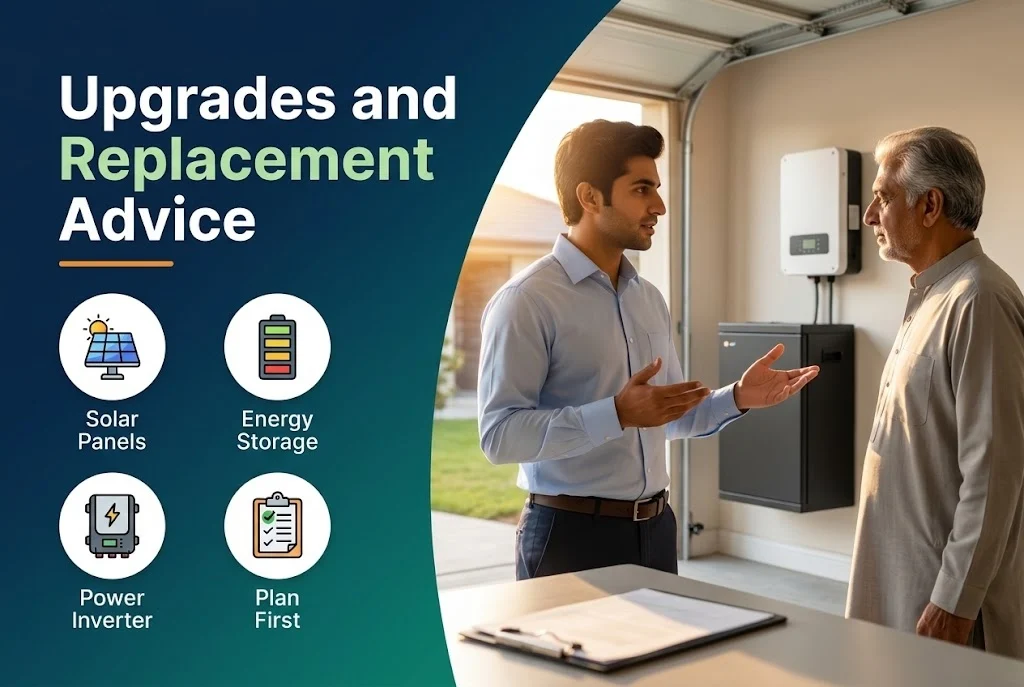
Your electricity needs do not stay the same forever. A household may add air conditioning, a shop may extend its opening hours, or a factory may install another machine. At the same time, solar panels, batteries and inverters age at different rates. These changes raise a practical question: should you expand the existing installation, upgrade one component or replace the system?
A well-planned solar system upgrade starts with measurements and compatibility checks, not with buying extra panels or a larger battery. The existing inverter, wiring, protection devices and mounting arrangement all place limits on what can safely be added. This guide explains the checks to make before spending money on solar equipment replacement or expansion.
Key takeaways
- Start by identifying what has changed: electricity use, backup requirements, equipment condition or available grid supply.
- Check inverter voltage, current, power and battery compatibility before adding equipment.
- Do not assume that panels or batteries can be mixed simply because their ratings look similar.
- Compare the cost and expected service life of a repair, an upgrade and a complete replacement.
- Have electrical work and commissioning completed by a qualified technician.
1. Decide what problem the upgrade should solve
Write down the reason you are considering a change. If electricity consumption has increased during daylight hours, additional solar generation may help, provided the roof and inverter can accommodate it. If the main problem is that essential equipment stops during load-shedding, extra battery capacity or a different backup arrangement may be more relevant. If the system repeatedly trips or produces less energy than before, diagnosis should come before expansion.
Review recent electricity bills and note the appliances or machines added since the system was installed. Separate daytime use from evening and night-time use. Also list the loads that must remain operational during an outage. This avoids paying for a larger solar array when the actual requirement is longer battery backup, or buying batteries when the problem is insufficient inverter output.
2. When adding solar panels makes sense
Adding panels can increase the energy available during suitable daylight conditions. It may be worth assessing when daytime consumption has grown, the existing array is smaller than the site’s present requirement, or unused inverter capacity is available. However, the roof area alone does not determine whether an expansion is possible.
The inverter manufacturer specifies limits for maximum PV power, input voltage, operating voltage range and input current. The proposed panel arrangement must stay within those limits in the site’s expected temperature conditions. The number of panels in a string affects voltage, while parallel strings affect current. A design that appears acceptable from the total wattage can still exceed an electrical input limit.
Shading and orientation also matter. New panels placed in a shaded area may not contribute as expected. Panels connected to the same string or MPPT input should be electrically compatible; mixing modules with different electrical characteristics can reduce the performance of the combined string. A technician should review the existing module model, inverter data sheet, string layout and available roof space before recommending an expansion.
3. Adding or replacing solar batteries
Battery decisions should be based on the loads that need backup and the number of hours they must operate. Make a list of essential equipment, its running power and, where relevant, its starting demand. A refrigerator, pump, air conditioner or industrial motor may draw a higher current when starting than while running. The inverter must be able to handle those demands as well as the continuous load.
Battery capacity is commonly stated in kilowatt-hours (kWh), while inverter output is stated in kilowatts (kW). These figures describe different things: stored energy and the rate at which power can be delivered. A battery with a large energy capacity does not automatically mean that it can supply every load. Check the battery’s continuous and peak discharge limits, the inverter’s battery current limits and the manufacturer’s approved combinations.
Do not connect a new battery to an older battery bank without confirming that the manufacturer permits the arrangement. Different ages, chemistries, capacities or states of health can create uneven charging and discharging. Lithium batteries also use a battery management system (BMS), and compatible communication and charge settings may be required. The inverter firmware and configuration should be checked against the battery manufacturer’s instructions.
4. When an inverter upgrade is necessary
An inverter may need attention when it has developed a fault, cannot support the required PV input, lacks the battery functions needed for a planned expansion, or no longer suits the site’s load profile. A newer model may provide different monitoring or operating features, but a replacement should not be selected on brand or advertised capacity alone.
Compare the inverter’s AC output rating, surge capability, PV input limits, MPPT arrangement, battery voltage, supported battery communication and protection requirements. For a grid-connected installation, also confirm that the equipment and proposed configuration meet the applicable connection requirements. A change of inverter can affect existing strings, isolators, breakers, cables, monitoring and commissioning settings.
If the existing inverter is simply showing an alarm, first identify the cause. A grid-voltage issue, poor connection, overheating, insulation fault or incorrect setting may be repairable. Replacing the inverter without diagnosing the underlying issue can leave the real fault unresolved. Read our guide to inverter repair and replacement before deciding.
5. Repair, upgrade or replace: how to compare
Ask for the fault or limitation to be explained in writing. A repair may be sensible when the equipment is otherwise suitable, parts are available and the repair restores safe operation. An upgrade may be better when the main components remain serviceable but the system needs additional capacity or a new function. Full replacement deserves consideration when several major components are near the end of their useful service life, compatibility is poor or repeated repairs are becoming uneconomical.
Compare more than the immediate quotation total. Include labour, transport, mounting changes, cables, protection devices, civil work, configuration, testing and commissioning. Ask whether existing equipment can be reused safely and what warranty applies to each new component. Do not assume that a new component extends the warranty or expected life of older equipment.
6. Information to collect before requesting a quotation
Prepare the inverter make and exact model, panel make and model, battery chemistry and model, installation date if known, and photographs of equipment labels. Share the inverter’s alarm history and monitoring screenshots if performance has changed. Include recent electricity bills, a list of new loads and the hours of backup you expect.
Photographs of the roof or ground-mounted array can help with an initial review, but they do not replace a site assessment. The technician may need to inspect cable routes, panel strings, isolators, distribution boards, earthing, ventilation, mounting condition and access. For larger commercial or industrial installations, production requirements and the effect of planned downtime should also be discussed.
7. Installation, civil work and commissioning
An expansion is not only an equipment purchase. Additional panels may require changes to mounting structures, roof penetrations, cable supports or access arrangements. A ground-mounted extension may require foundations and site preparation. Electrical work can include DC and AC cabling, isolators, breakers, surge protection, earthing and distribution-board changes. The exact scope depends on the existing installation and the proposed design.
After installation, the system should be inspected and commissioned according to the equipment instructions and applicable requirements. This can include checking polarity, insulation, protective devices, string voltage, operating parameters, battery communication and monitoring. Settings should reflect the installed equipment rather than being copied blindly from an older system. Ask for the final configuration and operating guidance to be explained at handover.
8. Common upgrade mistakes to avoid
- Buying panels before checking the inverter: the additional array may exceed voltage, current or power limits.
- Mixing incompatible batteries: different battery types or unsupported combinations can affect charging, safety and service life.
- Ignoring the load profile: more panel capacity does not automatically solve night-time backup requirements.
- Choosing only by the lowest quotation: omitted protection, structure, cable or commissioning work can create later costs.
- Skipping system records: keep model numbers, settings, test results and equipment documentation for future maintenance.
- Attempting live electrical work: solar DC circuits and battery systems can remain hazardous; do not open equipment or handle conductors yourself.
9. Planning an upgrade for homes, businesses and industry
For a home, the main questions are usually daytime consumption, evening use, essential backup loads, available roof area and the condition of the existing equipment. For a shop or office, operating hours, computers, cooling equipment and the cost of interruptions may carry more weight. For a factory or other industrial site, the review may need to include motor starting currents, load variation across shifts, critical production equipment, power quality and safe maintenance windows.
There is no single upgrade design that fits every site in Pakistan. Site conditions, equipment models, grid supply, weather exposure and the customer’s operating requirements differ. A proposal should be based on the actual installation and should clearly state what is being retained, removed, added and tested.
10. Get the existing system assessed
Atiq Traders supplies solar, inverter, battery and backup power equipment and provides installation, repair, maintenance and technical support. If you are considering a solar system upgrade, share the equipment details, recent bills, monitoring information and the change you want to make. Our team can review the requirements and advise whether an expansion, component replacement or further diagnosis is the appropriate next step.
Use the contact page or quotation form to discuss your site. You can also review our technical support, battery range and inverter range. A clear assessment before purchase helps ensure that the proposed equipment works with the system already in place.


Leave a comment