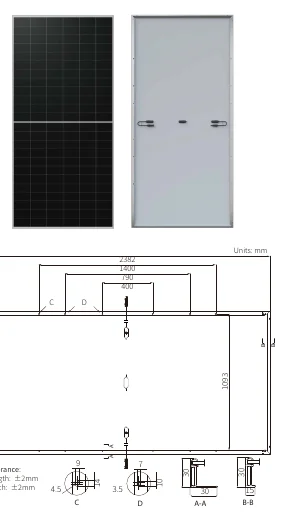
The LONGi Hi-MO X10 Explorer LR7-72HVH 630~650M series covers five power options across the 630–650 W range. This guide explains the full series dimensions and specifications. All five listed variants share the same external dimensions of 2382 × 1134 × 30 mm and weight of 28.5 kg. Module efficiency ranges from 23.3% to 24.1%, depending on the selected wattage.
This guide explains the LONGi Hi-MO X10 630~650M dimensions, what 630–650 W means, how to read the amp ratings and which details to compare before purchasing or designing a solar PV system in Pakistan. It focuses on the LR7-72HVH version rather than combining specifications from other Hi-MO X10 variants.
LONGi Hi-MO X10 630~650M size and dimensions
The LR7-72HVH 630~650M modules measure 2382 mm long × 1134 mm wide × 30 mm thick. In metres, that is approximately 2.382 m × 1.134 m × 0.030 m. Each module weighs 28.5 kg. The series uses 144 cells arranged in a 6 × 24 layout, single 3.2 mm coated tempered glass and an anodised aluminium alloy frame.
These measurements matter during the initial roof survey and layout design. A designer needs to allow for module dimensions, clamp zones, rail spans, row spacing, roof edges, walkways, access routes and any obstructions such as water tanks or ventilation equipment. The panel’s physical footprint alone does not establish how many modules can safely fit on a roof. Structural capacity, wind exposure, roof type, orientation and maintenance access must also be assessed.
LONGi Hi-MO X10 630~650M specifications at a glance
The table below compares the five LR7-72HVH 630~650M variants. Electrical values in the STC column are measured under the standard test conditions stated by the manufacturer. NOCT figures are a separate test set and should not be substituted for STC ratings when checking inverter limits.
| Specification | LR7-72HVH 630~650M series range |
|---|---|
| Maximum power (Pmax) | 630–650 W |
| Module efficiency | 23.3–24.1% |
| Cell technology | Back-contact (BC), TaiRay wafer |
| Cell layout | 144 cells (6 × 24) |
| Voltage at maximum power (Vmp) | 44.16–44.56 V |
| Current at maximum power (Imp) | 14.27–14.59 A |
| Open-circuit voltage (Voc) | 53.50–53.90 V |
| Short-circuit current (Isc) | 14.97–15.29 A |
| Dimensions | 2382 × 1134 × 30 mm |
| Weight | 28.5 kg |
| Glass | Single glass, 3.2 mm coated tempered glass |
| Maximum system voltage | DC 1500 V (IEC) |
| Maximum series fuse rating | 25 A |
| Operating temperature | −40°C to +85°C |
| Product / linear power warranty | 15 years / 30 years |
How many amps does a LONGi 630–650W solar panel produce?
A common question about the LONGi Hi-MO X10 630~650M series is how to interpret the module’s amp ratings. The exact current values vary by wattage and model code, so use the electrical table for the specific LR7-72HVH variant rather than assuming one current rating applies to the whole series.
Imp is the current delivered at the module’s maximum-power operating point, where its rated power is produced under the specified test conditions. Isc is the current measured when the module output is short-circuited. When selecting an inverter, cables, connectors and protective equipment, the designer must use the correct datasheet ratings and apply the required design factors and temperature considerations.
The 630–650 W series rating does not mean that a module always supplies its rated power or a fixed number of amps. Solar output changes with sunlight intensity, module temperature, shading, orientation, soiling and other site conditions. The rated power is a laboratory reference point, not a promise of constant real-world output throughout the day.
630–650 W range and amp difference: Imp, Isc, Vmp and Voc explained
People comparing LONGi Hi-MO X10 630~650M panel ratings often ask about amp differences or how to understand the electrical table. Four values are especially important:
- Vmp (44.16–44.56 V): voltage at the maximum-power operating point.
- Imp (14.27–14.59 A): current at the maximum-power operating point.
- Voc (53.50–53.90 V): open-circuit voltage when no load is connected.
- Isc (14.97–15.29 A): short-circuit current under the stated test condition.
At the maximum-power point, voltage multiplied by current is approximately the module’s rated power: 44.16–44.56 V × 14.27–14.59 A is approximately 630–650 W (minor differences can occur due to rounding). Voc multiplied by Isc is not the panel’s rated operating power because those two values do not occur together at the maximum-power point. This is why comparing only the amp number can lead to an incorrect conclusion about a solar panel’s output.
Why the exact LONGi Hi-MO X10 model code matters
The words “Hi-MO X10 630~650M” may appear on listings for more than one product variant. Always check the complete model code. This guide covers LR7-72HVH 630~650M series, which is a single-glass module with a listed weight of 28.5 kg. Other X10 model families, including LR7-72HVD versions, can have different construction, glass configuration, weight and electrical ratings. A listing that describes a dual-glass or bifacial model should not be assumed to describe this exact HVH module.
When comparing a 625 W, 635 W, 640 W, 630–650 W or 650 W module, check its model suffix and datasheet rather than relying on the series name alone. Modules can share a similar appearance while having different Pmax, Vmp, Imp, Voc, Isc, efficiency or mechanical properties. The selected module must also be compatible with the inverter’s MPPT voltage range, maximum DC voltage and input-current limits.
Efficiency and performance in Pakistan’s climate
The 630–650 W series has a stated module efficiency range of 23.3–24.1%. Its temperature coefficient of Pmax is −0.260%/°C, and its nominal operating cell temperature is 45 ± 2°C. The operating temperature range listed in the product information is −40°C to +85°C. These values help engineers model expected performance, particularly where modules may operate at elevated temperatures.
In Pakistan, high summer temperatures can raise module cell temperature and reduce instantaneous power compared with STC ratings. Good system design therefore considers ventilation beneath modules, mounting height, orientation, shading, dust accumulation, cleaning access, cable losses and inverter operating conditions. A 630–650 W label is useful for comparing module capacity, but annual energy production must be estimated using site-specific solar-resource and system-design inputs.
Mechanical strength, protection and warranty details
The LR7-72HVH 630~650M series specification lists front-side maximum static loading of 5400 Pa and rear-side loading of 2400 Pa. The hail test is stated as a 25 mm hailstone at 23 m/s. The junction box is rated IP68 and uses three diodes. Maximum system voltage is DC 1500 V (IEC), while the maximum series fuse rating is 25 A. These product ratings must be considered alongside the mounting manufacturer’s instructions, structural assessment, earthing, surge protection and local electrical requirements.
The product information lists a 15-year warranty for materials and processing and a 30-year linear power warranty. Published degradation is below 1% in the first year and 0.35% per year from year 2 to year 30, with 88.85% power stated at year 30. Buyers should review the current manufacturer warranty document and confirm the terms that apply to the exact model and supply channel before placing an order.
How to plan a solar system using 630–650W panels
System sizing should begin with the site’s energy consumption, daytime load profile, available installation area and grid or backup requirements. The engineer then checks roof or ground conditions, module orientation, shading, string configuration and inverter compatibility. The number of modules cannot be determined from panel wattage alone. The inverter’s maximum DC voltage, MPPT range, input-current limit and the module’s temperature-adjusted electrical values all affect the permitted string arrangement.
For commercial and industrial sites, the design should also consider distribution-board capacity, protection coordination, cable routing, isolation points, monitoring and safe maintenance access. A site survey is important before confirming the final bill of quantities or expected generation. These checks reduce the risk of ordering modules that do not suit the project’s roof, electrical design or operating needs.
Where to check the LONGi Hi-MO X10 630~650M product details
If you are comparing the LONGi Hi-MO X10 630~650M dimensions or amp ratings, confirm the full model code and matching datasheet before purchasing. Review the module listing, specifications and datasheet on the Atiq Traders LONGi Hi-MO X10 630~650M solar panel product page.
Atiq Traders supplies solar equipment and supports solar installation and after-sales requirements across Pakistan. For a project quotation, share the site location, approximate system capacity, roof or ground-mount details and any inverter preference so the technical requirements can be reviewed. Product availability and commercial pricing should be confirmed at the time of inquiry.
Frequently asked questions
What is the size of a LONGi Hi-MO X10 630~650M solar panel?
The LR7-72HVH 630~650M series measures 2382 × 1134 × 30 mm and weighs 28.5 kg.
How many amps is the LONGi 630–650W panel?
Its current at maximum power (Imp) is 14.27–14.59 A, while its short-circuit current (Isc) is 14.97–15.29 A at STC.
Is the LONGi Hi-MO X10 630~650M panel bifacial?
The LR7-72HVH 630~650M series covered here is specified as a single-glass module. Do not assume it has the same construction as other Hi-MO X10 model families; verify the full model code and its datasheet.
Does a LONGi Hi-MO X10 630~650M panel always generate its rated wattage?
No. 630–650 W is the rated maximum power under STC. Real output varies with sunlight, temperature, shading, orientation, soiling and system losses.


Leave a comment