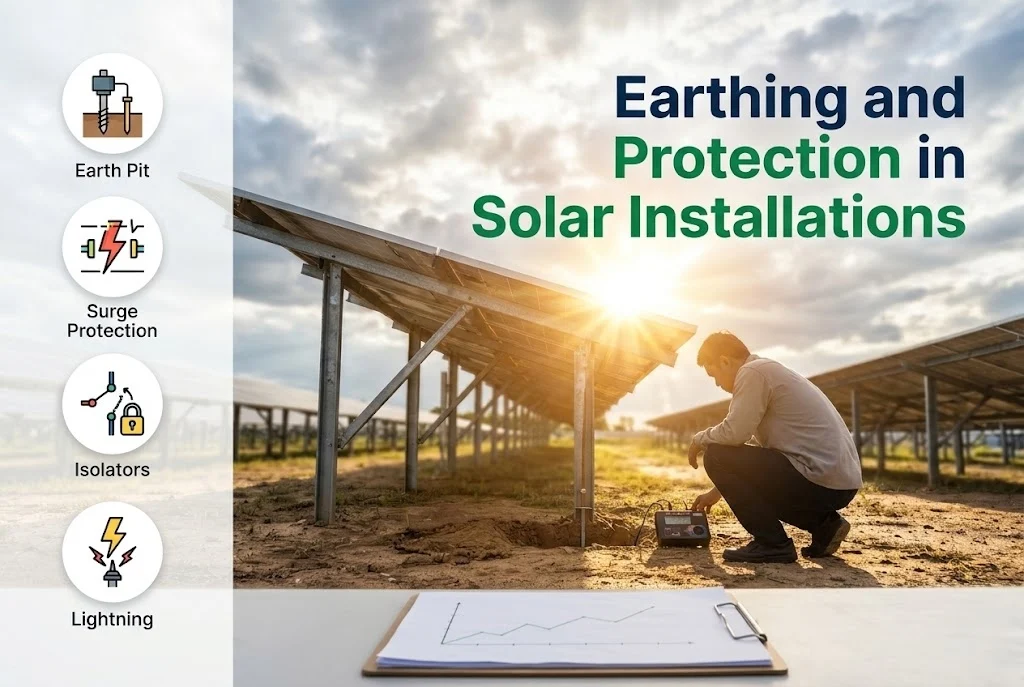
Earthing and protection are the parts of an installation that you hope never to use. They limit the harm from a fault, a surge or a lightning strike, and protect people and equipment.
They are fitted at installation and tested before handover.
Key takeaways
- All metal parts of the system are bonded and connected to a tested earth.
- Surge protection devices guard the inverter and the cables.
- Breakers, fuses and isolators protect and isolate each circuit.
- Test results are recorded and handed to the owner.
Earthing
The panel frames, the mounting structure, the inverter and the cabinets are bonded together with earth conductors and connected to an earth electrode or to the building’s earth system. A good earth gives a fault a safe path and makes protection devices work. Its resistance is measured after installation.
Protection devices
- DC isolators so that the panels can be isolated from the inverter.
- Fuses or breakers on the DC and AC circuits, sized for the current.
- Surge protection devices on the DC and AC sides.
- Residual-current protection where the design needs it.
Lightning
A lightning strike near the building can send a surge along the cables. Surge protection and good earthing reduce the risk to the inverter and the panels. If the building already has lightning protection, the solar earthing is joined to it correctly.
Tests at handover
We measure the earth resistance, check the continuity of the bonding, test the protection and the isolators, and record it all. The record is handed to you with the system. For checks later in the life of the system, see checking and tightening electrical connections.
When to call us
We install and test earthing and protection with every system. Use the quote page, see our installation services, or look at the UPS systems and protection equipment we supply.
Leave a comment