
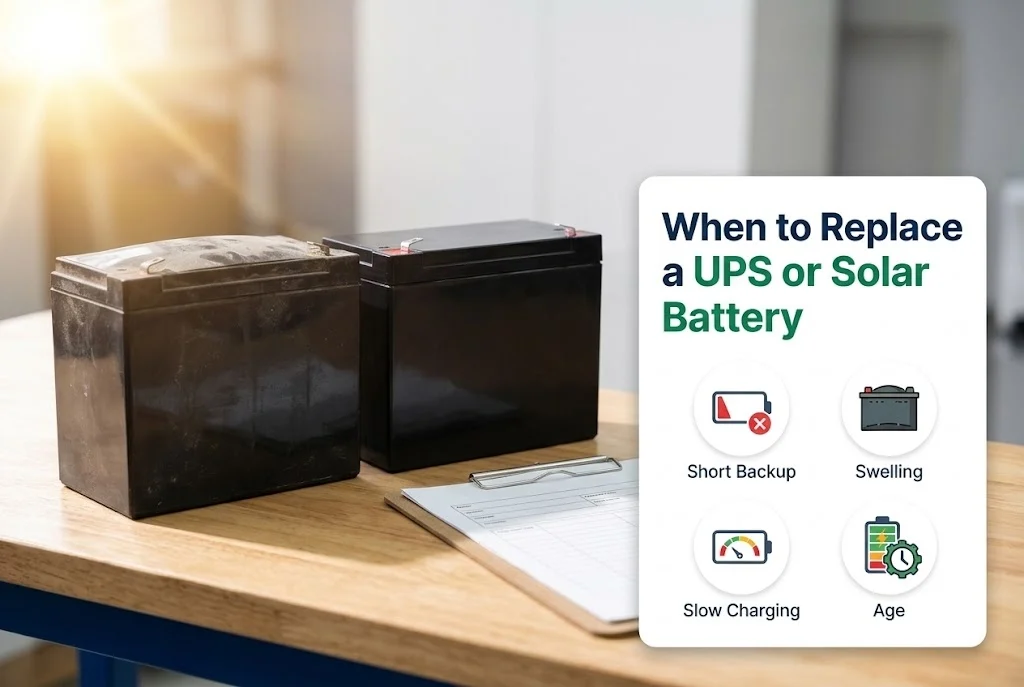
Every rechargeable battery loses capacity over time. The challenge is deciding when it no longer provides the backup required by the home or business. Replacing a battery too late can leave critical equipment without power during an outage, while replacing it too early can waste money. A decision should be based on battery condition, runtime requirements and the manufacturer’s guidance.
This guide explains when to consider UPS battery replacement or solar battery replacement, which warning signs matter and what to check before buying a new battery. Requirements vary by chemistry and model, so always consult the exact product manual and warranty.
Key points
- Shorter backup runtime is a common sign of reduced battery capacity.
- Alarms, swelling, leakage and unusual heat require attention.
- Test the battery and charging system before deciding to replace it.
- Replacement voltage, capacity and chemistry must match the equipment.
- Battery handling and disposal should follow safety procedures.
1. Shorter backup time
If a UPS or inverter previously supported the same appliances for longer but now shuts down quickly, battery capacity may have declined. Compare runtime under similar load conditions and check whether additional equipment has been connected since the original installation.
For a fair comparison, record the connected load, battery state, outage duration and system alarms. A larger load or changed operating pattern can reduce runtime even if the battery is still serviceable. The battery should be tested before replacement is approved.
2. Battery alarms and failed self-tests
Some UPS models display replace-battery warnings or report a failed self-test. Hybrid inverters may show battery communication or protection alarms. The exact message depends on the product and should be checked against the manufacturer’s manual.
A warning may indicate a battery problem, but it can also be caused by charging, wiring or communication issues. Record the model and exact code and arrange a technical assessment rather than clearing the alarm repeatedly.
3. Physical warning signs
Swelling, leakage, cracks, unusual heat, corrosion or an unusual smell are warning signs. Keep people clear of a damaged battery and seek qualified assistance. Do not open a sealed battery, puncture the enclosure or attempt an improvised repair.
If there is smoke, visible arcing or a burning smell, follow the site’s emergency procedure. Do not touch damaged cables or battery terminals. The battery should not be returned to service until it has been assessed safely.
4. Battery age and service history
Battery life depends on chemistry, product design, temperature, charging conditions, discharge depth and usage frequency. A battery that operates in a hot room or experiences frequent deep discharges may age faster than one used under favourable conditions.
Check the installation date, model and previous test results. The manufacturer’s expected service life is based on defined conditions and should not be treated as a guaranteed replacement date for every installation.
5. Test the battery before replacement
Testing methods depend on the battery type and application. A technician may inspect the battery, review voltage and charging behaviour, use an approved conductance or capacity test and compare the result with manufacturer limits. For some systems, a controlled runtime test may be appropriate.
A single voltage reading does not necessarily reveal the battery’s available capacity. Test results should be interpreted alongside battery age, temperature, load and charging history. Do not perform live electrical tests yourself.
6. Check the charger and inverter
A battery may underperform because the charger or inverter is not operating correctly. Incorrect charging settings, a failed charger, loose connections or communication faults can affect battery performance. Replacing the battery without checking the charging system may cause the new battery to deteriorate in the same way.
A qualified technician can review charging voltage, current, alarms and settings. Do not change charge parameters without the battery and inverter manuals. For lithium systems, confirm that BMS communication and protection are functioning correctly.
7. Select the correct replacement battery
Check nominal voltage, capacity, chemistry, maximum charge and discharge current, dimensions, terminal type and approved operating conditions. The replacement must be compatible with the UPS or inverter’s DC bus and charger. A battery that fits physically may still be electrically unsuitable.
For multi-battery banks, follow the manufacturer’s instructions for series and parallel arrangements. Do not mix batteries of different models, capacities or ages unless the manufacturer explicitly permits it. Confirm whether the complete bank should be replaced together.
8. Lead-acid versus lithium replacement
Lead-acid batteries include flooded, AGM and gel designs, each with different charging and maintenance requirements. Lithium batteries, including LiFePO4, use a battery management system and have their own voltage, current and communication limits.
Do not substitute lithium for lead-acid or vice versa without confirming that the UPS or inverter supports the chemistry. Check the approved battery list, charging profile, BMS protocol and warranty conditions. A nominal voltage match is not enough.
9. Battery replacement safety
Batteries can deliver high fault current and may retain energy even when the mains supply is disconnected. Replacement should follow the manufacturer’s isolation procedure and be performed by trained personnel using suitable protective equipment. Polarity, cable size, terminal torque and protective devices must be checked.
Do not short battery terminals with tools or bypass a fuse or breaker. Use the correct connectors and cables. After replacement, the system should be commissioned and tested before being relied on for backup.
10. Installation environment
Place the replacement battery in a location that meets the manufacturer’s temperature, ventilation, clearance and mounting requirements. Avoid direct sunlight, water exposure, heat sources and physical damage. The floor, wall or rack must support the battery’s weight.
Keep the area accessible for inspection and service. Do not cover ventilation openings or store materials around the battery. Requirements differ by chemistry and model, so use the exact installation manual.
11. Disposal and warranty records
Old batteries should not be placed in ordinary household waste. Ask the supplier or an appropriate recycler about safe collection and disposal. Keep the replacement invoice, serial number, warranty document and installation date.
Record any test results and settings changes. These documents help with future maintenance and warranty claims. For a multi-battery bank, maintain a record of each unit and its position in the system.
12. How to extend battery service life
Use the correct charging profile, maintain a suitable temperature and avoid discharging beyond the manufacturer’s permitted limits. Review alarms promptly and arrange inspection if runtime falls. For systems with frequent outages, confirm that the battery capacity and charging source suit the operating duty.
Periodic checks can identify deterioration before the system fails during an outage. Follow the manufacturer’s maintenance schedule and replace batteries when their measured condition no longer meets the required backup duration.
Battery replacement support across Pakistan
Atiq Traders supplies UPS and solar batteries and provides installation, repair and maintenance support for residential, commercial and industrial customers across Pakistan. Battery replacement depends on the existing equipment, chemistry, required runtime and installation conditions.
For a battery assessment or quotation, use the quotation form or contact us through the contact page. You can also browse our battery range, UPS range and maintenance services.
13. Confirm the system meets the original backup requirement
After replacement, compare the new battery bank with the load and runtime that the home or business actually needs. If the protected equipment has changed, the original battery size may no longer be adequate. Ask the technician to document the connected load, battery configuration and approved runtime test. This provides a useful baseline for future maintenance and helps determine when the next battery assessment should take place.


Leave a comment