
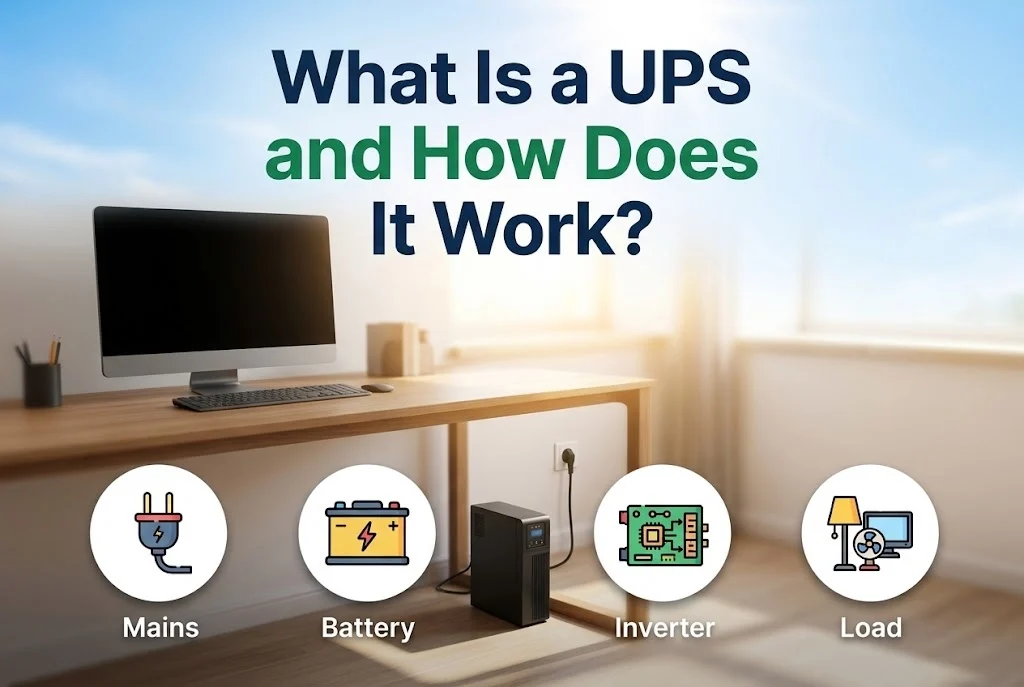
A UPS (uninterruptible power supply) keeps important equipment running when the mains fails, and cleans up the power when it is poor. It is the standard answer for computers, servers, medical and industrial equipment that cannot just switch off. Here is how it works.
Key takeaways
- A UPS has a charger, a battery, an inverter and a bypass path.
- It protects against outages, sags, surges and noise, depending on its type.
- Backup time is usually minutes, enough to shut down safely or let a generator start.
- It is not a replacement for a generator or a solar and battery system for long outages.
1. The parts of a UPS
- Rectifier or charger: turns AC into DC to charge the battery.
- Battery: stores energy, usually sealed lead-acid, sometimes lithium.
- Inverter: turns the DC back into clean AC for the load.
- Static bypass: a switch that passes mains power directly to the load if the UPS has a fault or is overloaded.
- Control and display: manage the system and report alarms.
2. What happens in a power cut
When the mains fails, the UPS takes energy from the battery and makes AC through the inverter. How quickly this happens depends on the type; an online UPS has no break at all, others take a few milliseconds. See online, line-interactive and offline UPS.
3. What it protects against
A UPS can protect against complete power loss, brownouts (low voltage), over-voltage, surges and, in the higher types, frequency changes and electrical noise. In Pakistan, where voltage swings and short outages are common, this protection also reduces damage to electronics.
4. What it does not do
A UPS has a limited battery. It will not run an office for hours unless it has a very large battery, and it is not designed for starting large motors or air conditioners. For long outages you need a generator or a solar and battery system; see home backup: UPS or solar hybrid.
5. Sizes and uses
Small UPS units protect a computer and a router, such as the APC Back-UPS Pro 900VA. Larger units protect a server room, a shop or an entire process, such as the APC Smart-UPS RT 10 kVA, and industrial three-phase UPS units protect plants. See how to size a UPS.
6. Care
Batteries are the part that wears out first; see UPS maintenance routine.
Next step
Tell us what you need to protect and for how long, and we will recommend a UPS; use the quotation form or see our UPS solutions.


Leave a comment