
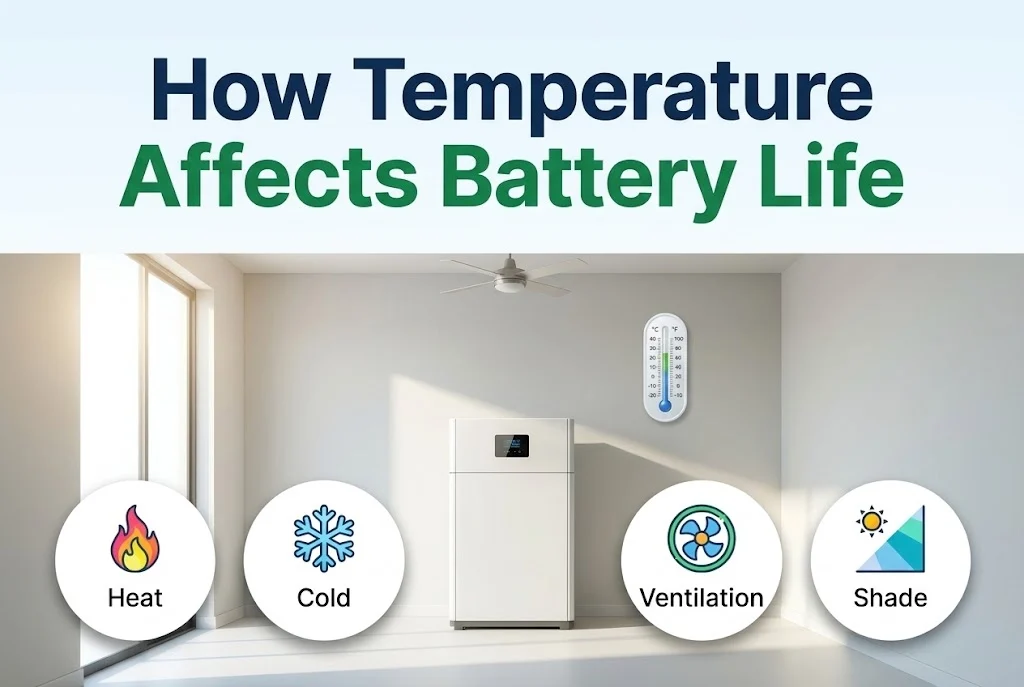
Battery datasheets quote their life at a comfortable room temperature, around 25 °C. In Pakistan, summer room temperatures in a closed store or a roof-top cabin can reach far higher. Heat quietly shortens battery life more than almost anything else, and it is the easiest factor to improve.
Key takeaways
- Heat speeds up the chemical ageing of every battery type.
- A commonly quoted rule for lead-acid batteries is that life roughly halves for every 8 to 10 °C above 25 °C.
- Cold reduces capacity and, for lithium, limits charging; it does not damage a battery the way heat does.
- Ventilation, shade and spacing cost little and save a lot.
1. What heat does
Inside a battery, the reactions that wear it out go faster when it is warm. For lead-acid batteries this means faster corrosion of the plates and drying out of the electrolyte, and a battery that was meant to last ten years may need replacing in half that time. Lithium batteries also age faster when kept hot, particularly while fully charged.
2. What the datasheets say
Manufacturers give a recommended range. For example, the datasheet of the Narada Eos-2000 cell lists a recommended operating temperature of 15 to 25 °C, with a wider maximum operating range, and the Greenage GVEs-51.2 lithium battery lists a recommended range of 15 to 35 °C. See the Eos-2000 and GVEs-51.2 pages. The recommended range, not the maximum, is the one to aim for.
3. What cold does
At low temperatures a battery delivers less capacity, so backup time falls. Lithium batteries usually must not be charged below about freezing point, and the battery management system will block it. Winter in most of Pakistan is mild for this purpose, but a very cold unheated room in the north needs care.
4. Charging and temperature
A charger that compensates for temperature lowers the charge voltage when it is hot and raises it when it is cold. Without it, a hot battery gets overcharged, which makes the problem worse. Ask if your charger or inverter has a temperature sensor, and use it if so. See VRLA batteries: AGM vs gel.
5. How to keep batteries cool
- Choose a room away from direct sun and heat sources; avoid roof-top cabins in full sun.
- Provide ventilation, or air conditioning for a large battery room.
- Leave gaps between batteries so air can move.
- Keep batteries off the hot walls and away from inverters and transformers, which give off heat.
- Use a thermometer and check it in the hottest months.
6. Put it into the budget
If you cannot keep the room cool, plan for a shorter life, choose a type that handles heat better and size the bank with a margin. See when to replace a UPS or solar battery.
Next step
Send us a photo of your battery room, and we will advise on cooling and layout; use the contact page.


Leave a comment