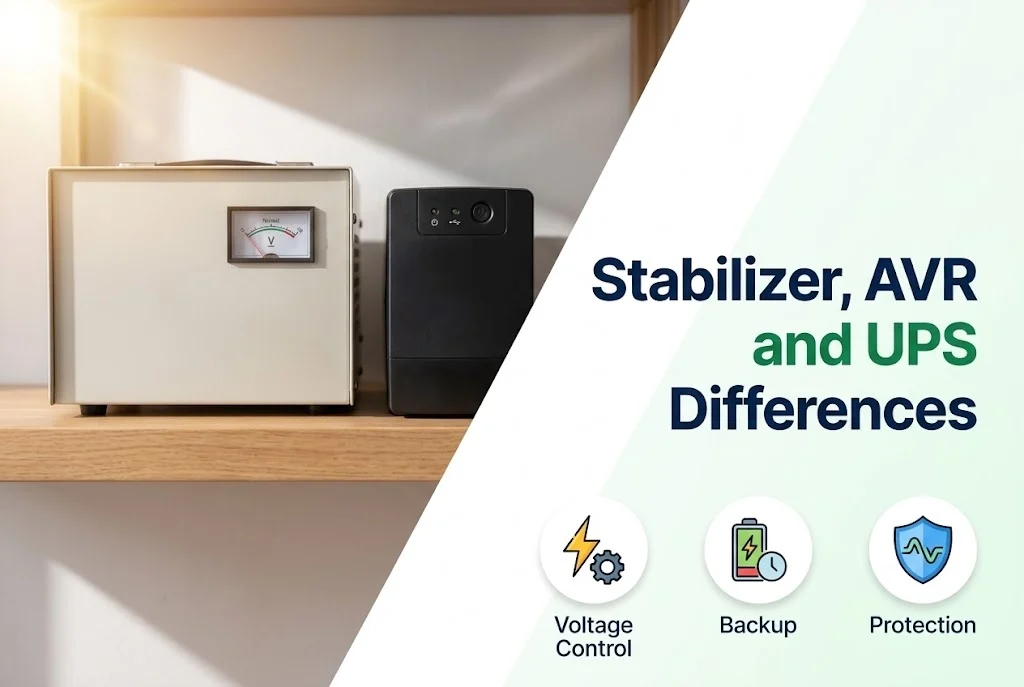
In many parts of Pakistan the supply voltage can go too low or too high, as well as fail altogether. People then ask whether they need a stabilizer, an AVR or a UPS. They overlap, but each does a different job.
Key takeaways
- A stabilizer corrects voltage but gives no power when the mains fails.
- An AVR is the voltage-correcting circuit; it comes inside many line-interactive UPS units.
- A UPS provides backup from a battery, and some types also correct voltage.
- Choose by the problem you actually have: voltage, outages or both.
1. Voltage stabilizer
A stabilizer keeps the output voltage within a narrow range when the input voltage swings. Servo types use a motor that moves a transformer tap; relay and static types switch taps electronically. A stabilizer suits equipment that is harmed by low or high voltage, such as refrigerators and air conditioners, but it gives no power in an outage.
2. AVR
AVR stands for automatic voltage regulator, which does what the stabilizer does. The term is often used for the voltage correction inside a line-interactive UPS, which raises or lowers the voltage by switching a transformer. When the input is out of the range, or fails, the UPS goes to battery. See online, line-interactive and offline UPS.
3. UPS
A UPS keeps loads running on battery when the mains is lost. Offline units give little voltage correction, line-interactive units correct moderate swings, and online units provide clean, regulated power at all times. The UPS battery is designed for minutes, not hours.
4. Which problem do you have?
- Voltage swings only: a stabilizer or a line-interactive UPS.
- Short outages and sensitive equipment: a UPS.
- Both, with long outages: a stabilizer plus a UPS or a solar hybrid system.
- Motor loads such as air conditioners and pumps: a properly sized stabilizer, or protection with under-voltage and time-delay features; a small UPS is not suitable.
5. Practical tips
Measure the voltage at your board at different times of the day before you buy. Size a stabilizer by the load in kVA and check the input range it covers. Do not put heavy loads on a small UPS. For appliances with compressors, a time delay on restart protects them.
6. Solar and voltage problems
A grid-tied solar inverter disconnects when the grid voltage is out of its allowed range. A poor supply can therefore reduce solar production; see why your inverter waits after a power cut.
Next step
Tell us about your supply and loads and we will advise on a stabilizer, UPS or hybrid system through the contact page or the quotation form.

Leave a comment