
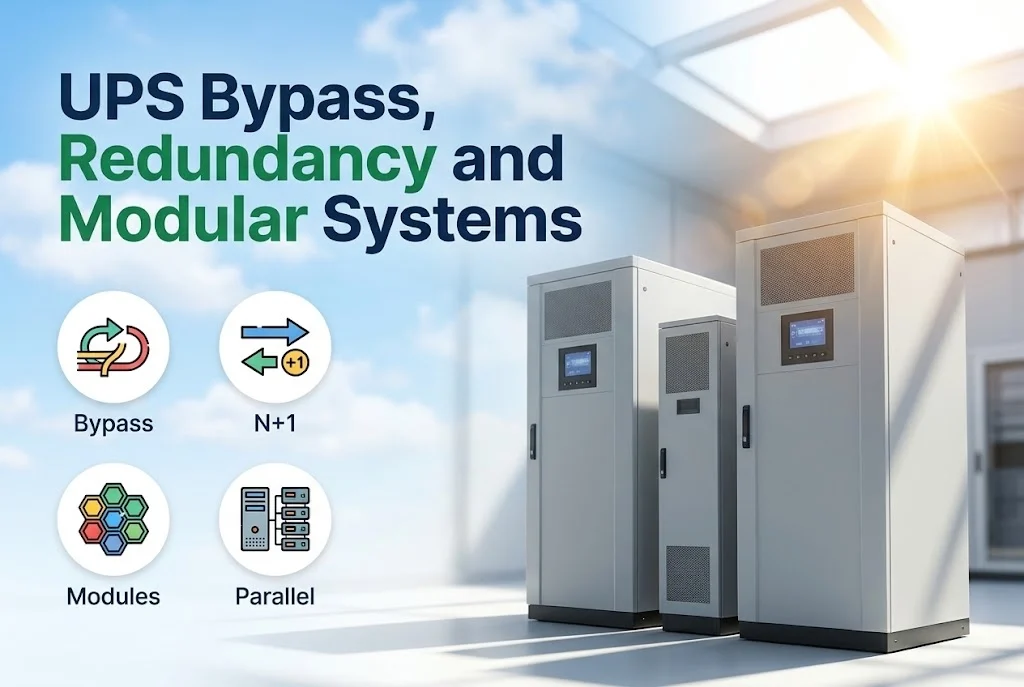
When a UPS protects something critical, the question is no longer only "how big", but "what happens if the UPS itself fails or needs service". Bypass, redundancy and modular design are the answers. Each adds cost and complexity, so it helps to know what you are buying.
Key takeaways
- A static bypass protects against UPS failure or overload; a maintenance bypass allows service without shutdown.
- Redundancy such as N+1 means there is a spare unit, so one can fail without losing the load.
- Modular UPS systems are built of power modules that can be added or replaced while running.
- The right level depends on how costly an interruption would be.
1. Static bypass
If the inverter overloads or fails, a static bypass transfers the load to the mains almost instantly. The load is then unprotected, but it stays on. It is a standard feature in good online UPS units.
2. Maintenance bypass
A manual switch that routes the mains directly to the load so that the whole UPS can be isolated, for service, repair or replacement. Without it, the load must be shut down for any work on the UPS. For a plant or data room this is essential.
3. N+1 redundancy
In a parallel redundant system, there are enough UPS units or modules to carry the load (N), plus one more (the +1). If one fails, the others carry the load without interruption. It protects against a failure of a unit, but not against a problem in shared parts such as the output board, which is why some sites go further.
4. Modular UPS
A modular UPS is built from power modules in a cabinet, such as in the Socomec MODULYS GP or the APC Symmetra PX. Capacity can be increased by adding modules, and a faulty module can be swapped, often without turning the system off. This saves floor space and shortens repair time.
5. Choosing the level
- For ordinary offices and small equipment: a single UPS with a bypass is usually sufficient.
- For plants and data rooms: add a maintenance bypass and consider N+1.
- For very critical loads: a fully redundant design with separate supply paths.
Compare the cost of the extra equipment with the cost of an hour of downtime.
6. Do not forget the batteries and the supply
A redundant UPS with a single battery string or a single supply still has a single point of failure. Batteries need testing; see UPS maintenance routine.
Next step
If you are planning protection for a critical load, we can help you choose the right design; see three-phase UPS for industry, our industrial UPS solutions or the quotation form.


Leave a comment