
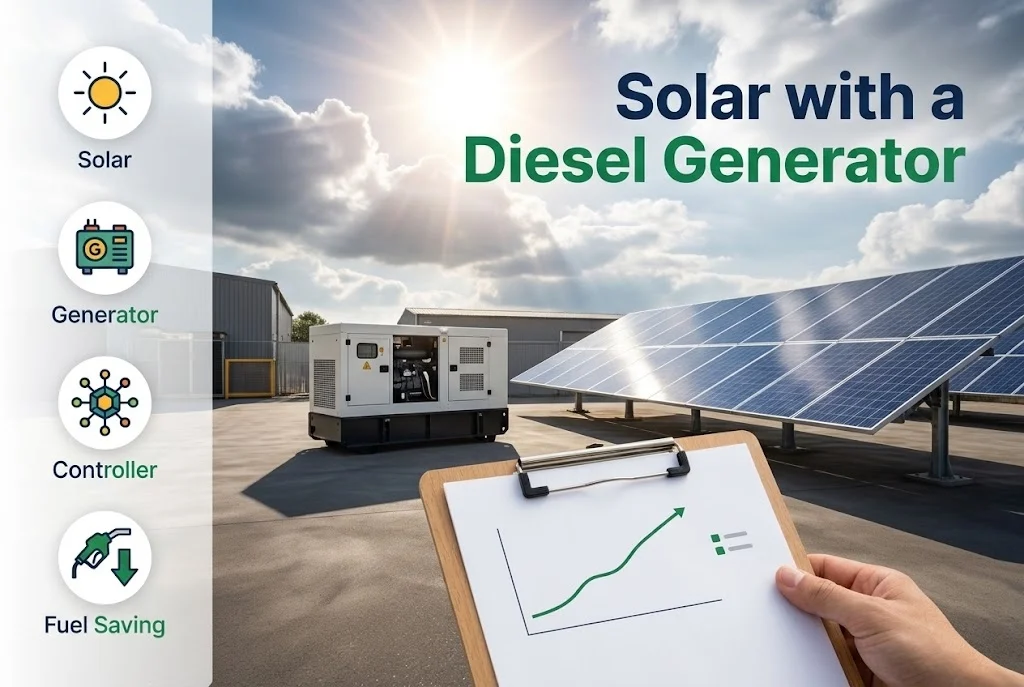
Many sites in Pakistan depend on a generator when the grid fails. Fuel is costly, and the generator runs below its best efficiency at light load. Adding solar can cut the fuel use, but the two must be connected properly. A poor design can damage the generator or stop the solar from working.
Key takeaways
- A normal grid-tied inverter needs a stable source; a generator is not always one.
- The solar output must never exceed what the load and the generator can take at the moment.
- A controller limits the solar so that the generator is not pushed backwards or run too lightly.
- Design and settings must come from an engineer who knows both.
1. Why combine them
A generator burns fuel in proportion to the load. If solar supplies part of the load by day, the generator burns less, or can be switched off. Over a year this can lower the fuel bill and the running hours, which reduces wear and service costs.
2. The reverse-power problem
If the solar supplies more than the load needs, the surplus tries to flow into the generator, which it cannot take. This is called reverse power and it can trip the generator or damage it. A solar controller must limit the output to a level below the load, for example by reading the load and the generator.
3. Minimum load on the generator
A diesel generator runs poorly at very light load, with wet stacking and carbon build-up. Many designs limit solar so that the generator stays above a minimum load, typically a share of its rating given by the generator maker. Solar then lowers the load but not to zero.
4. Inverter behaviour
Not every inverter works with a generator. A grid-tied inverter must see steady voltage and frequency and may trip if the generator is unstable. A hybrid inverter with a generator input, or a battery-based design, handles this better. Check the datasheet and the maker's approval. See choosing a hybrid inverter.
5. Adding batteries
A battery can store the surplus solar and run the loads while the generator is off, so the generator starts only when the battery is low or the load is high. This can reduce generator hours a great deal but adds cost.
6. Control and protection
A solar-diesel system needs a controller that measures the load and the generator, an interlock so that the grid and the generator never connect together, and proper protection and earthing. Ask for the single-line diagram and the control logic.
Next step
If you run a generator today, send us the details through the quotation form and we will assess a solar link; see also solar for factories.


Leave a comment