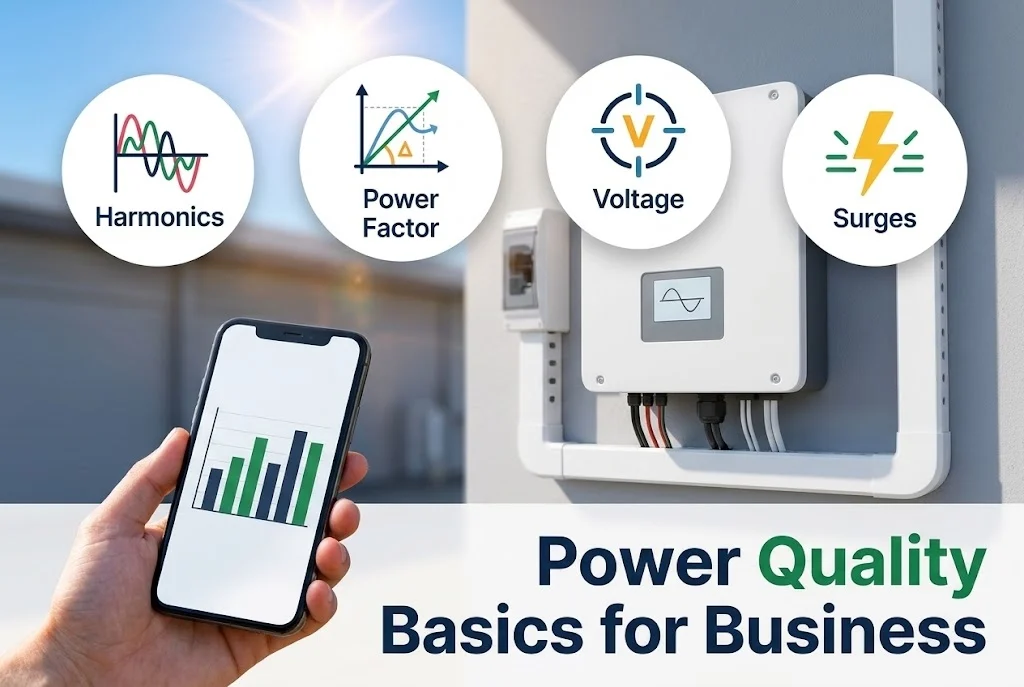
"Power quality" describes how close the electricity at your plant is to a clean, steady supply. A poor supply can overheat motors, trip breakers, damage electronics and add to the bill. Three terms come up most often: voltage problems, harmonics and power factor.
Key takeaways
- Voltage should stay near the nominal value; sags, swells and imbalance harm equipment.
- Harmonics are distortions of the current or voltage caused by electronic loads such as drives and rectifiers.
- A low power factor means you draw more current than needed for the useful work, and it may be charged on your bill.
- Measure before you buy a solution: a power quality analyser shows what is really happening.
1. Voltage problems
A sag is a short drop in voltage, a swell is a short rise, and a long under- or over-voltage lasts minutes or hours. Imbalance between the phases of a three-phase supply overheats motors. Causes are on the network or inside the plant, such as large motors starting. Stabilizers, UPS units and correct cable sizing help; see stabilizer, AVR and UPS differences.
2. Harmonics
Variable speed drives, rectifiers, LED lighting, computers and UPS units draw current in pulses rather than a smooth wave. This distorts the supply and can overheat transformers and neutral conductors, trip breakers and disturb sensitive equipment. Filters, better UPS input design and correct cable sizing reduce the effect.
3. Power factor
Power factor is the ratio of real power (kW) to apparent power (kVA). Motors and transformers draw reactive current that does no useful work, so the power factor falls. The supply company may charge a penalty for a low power factor on commercial and industrial connections, depending on your tariff. Capacitor banks improve it, and they must be designed to avoid harmonic problems.
4. Solar and power quality
A solar inverter is also an electronic load and source. A good inverter has low harmonic output and can supply or absorb reactive power within its limits, where the grid code allows it. It will stop when the grid is outside its voltage and frequency window, so a poor supply reduces solar production. See why your inverter waits after a power cut.
5. UPS and power quality
An online UPS delivers clean voltage to the loads, but it draws its own input current. Check the input harmonic distortion and the input power factor of a large UPS; see three-phase UPS for industry.
6. Start with a measurement
Rent or buy an analyser and log the supply for a week or two. The data shows the problems and sizes the cure, so you do not buy equipment that does not solve the issue.
Next step
If you suspect power quality problems at your site, contact us through the contact page or the quotation form.
Leave a comment