
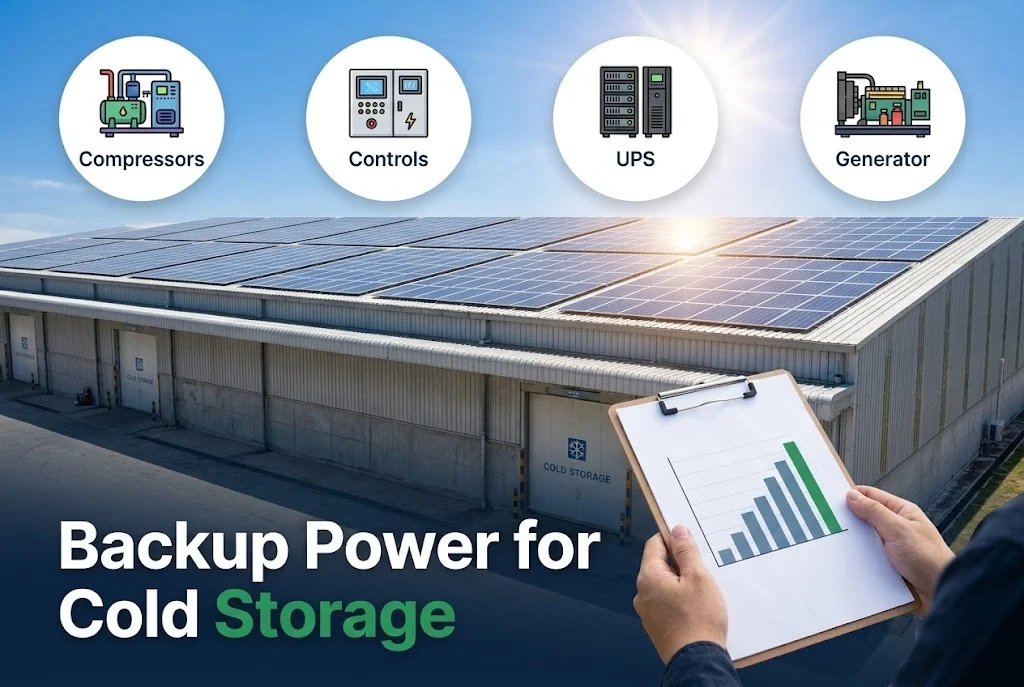
When a cold store loses power, the temperature starts to rise, and what is inside is at risk. The cost of the stock can far exceed the cost of the backup. Planning begins with the loads and the time you can safely survive without power.
Key takeaways
- List the critical loads: compressors, fans, controls, alarms and lighting; decide what must run during an outage.
- Compressors and motors draw a big starting current, which sets the size of the generator or the inverter.
- A UPS protects the controls and monitoring; a generator or battery system carries the compressors.
- Solar can cut the daytime power cost, but it must be designed with the starting surges in mind.
1. Know how long you can wait
Insulation, door openings and the stock itself decide how fast the temperature rises. Ask your refrigeration contractor for the safe time. If it is short, the backup must start almost at once, and if it is long, you may be able to use a generator with a short delay.
2. Critical circuits
Separate the critical circuits from the rest, so that during an outage you power only what you must. The controls, sensors and alarms need clean, uninterrupted power, which a UPS gives. Compressors can run on a generator or a large inverter and battery.
3. Starting current
A compressor may draw several times its running current for a moment at start. The generator or inverter must handle this, and soft starters or variable speed drives can reduce it. This is a main reason why backup for refrigeration is bigger than the running load suggests. See how to size a UPS.
4. Generator, UPS and batteries
A common design uses a generator for long outages, with an automatic transfer switch, and a UPS for the control system during the transfer. Larger sites may add batteries to avoid generator starts for short outages. See three-phase UPS for industry.
5. Solar for the daytime load
Cold stores use power day and night, but a solar system can carry a good part of the daytime load. The roof is often large and flat. For an example of this kind of work, see our 300 kW solar project at Mushtaq Cold Storage. With batteries or a generator link, it can also support the critical load; see solar with a diesel generator.
6. Monitoring and alarms
Temperature alarms that send a message, backup power status and regular tests of the generator and the UPS are part of the plan, as is a maintenance routine.
Next step
Tell us about your cold store and its loads, and we will propose a backup and solar plan; use the quotation form or see our industrial solar and industrial UPS solutions.
Leave a comment