
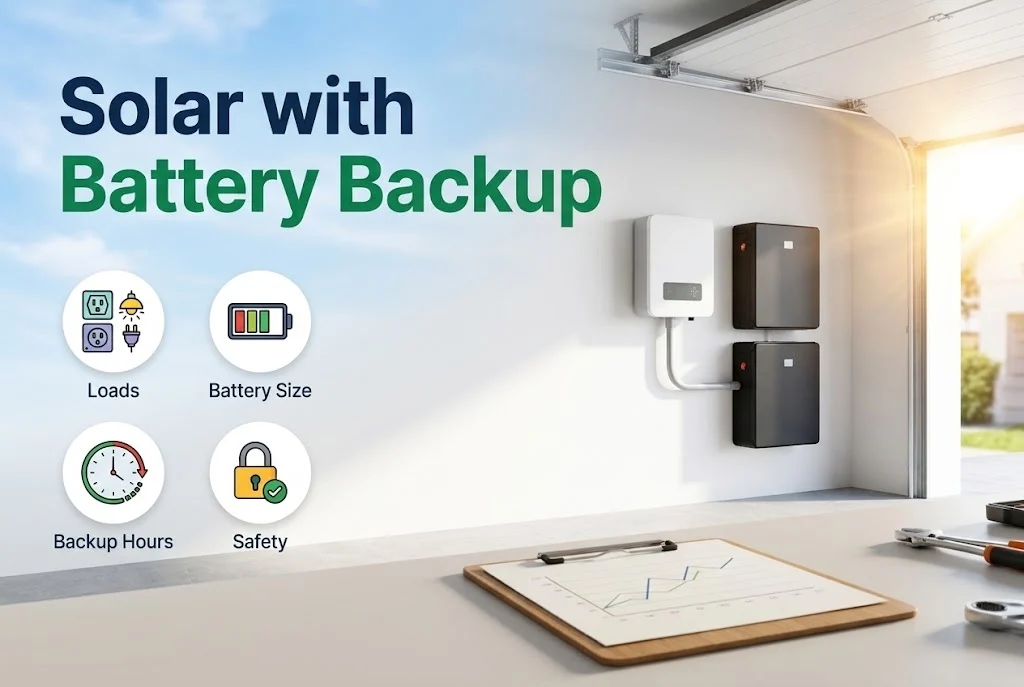
Solar panels can generate electricity during the day, but they do not automatically keep a home powered during a grid outage. Battery storage and a suitable hybrid inverter are needed if the system is expected to supply selected circuits when the utility is unavailable. The battery determines how much stored energy is available, while the inverter determines how much power can be delivered to the appliances.
Home solar battery backup should be planned around essential loads and the number of hours they need to operate. This guide explains how to estimate battery capacity, choose a compatible inverter and understand the limitations of backup operation.
Key points
- List essential appliances before choosing battery capacity.
- Calculate energy use from watts multiplied by runtime.
- Use usable battery kWh rather than nominal capacity alone.
- Check inverter power and motor starting capability.
- Confirm which household circuits are connected to backup output.
1. Decide what should remain powered
Start by separating essential appliances from optional loads. Essential items may include lights, fans, a refrigerator, router, security equipment and selected sockets. Air conditioners, water pumps, electric heaters and cooking appliances can require much higher power and may not be practical on a small backup system.
Record the rated power and expected operating hours of each appliance. Consider whether equipment runs continuously or cycles automatically. The backup plan should state which appliances can operate together and which should be switched off during an outage.
2. Calculate required backup energy
For each appliance, multiply its power in watts by the number of hours it is expected to run. Add the energy values to estimate the total watt-hours required. Divide by 1,000 to convert the result to kWh. This is the energy required at the AC loads before accounting for system losses.
For example, a 100 W fan running for five hours uses approximately 500 Wh. Several appliances are calculated separately and then added. Actual energy use may vary with appliance cycling, speed settings and operating conditions.
3. Understand usable battery capacity
A battery’s nominal kWh rating is not necessarily the amount available to the home. The manufacturer’s permitted depth of discharge, minimum state of charge, BMS limits and operating conditions determine usable energy. Inverter conversion losses also reduce the energy delivered to AC appliances.
Use the manufacturer’s usable energy figure for planning. If a battery is advertised at a particular nominal capacity, ask how much energy is available under the intended operating conditions and what reserve is retained. Battery ageing can also reduce available capacity over time.
4. Check inverter power and surge capability
The inverter must support the total load that may operate at the same time. Its continuous output rating should be sufficient for the connected appliances, and its surge capability must support equipment such as refrigerator compressors or water pumps during start-up.
Check whether the backup output has a lower rating than the inverter’s main AC output. Some hybrid models support only selected circuits or have a defined maximum backup power. Do not assume that the inverter can run every appliance in the home.
5. Choose the battery chemistry
Home battery systems may use lithium iron phosphate or lead-acid technology, including AGM and gel products. They differ in usable capacity, charging requirements, cycle life, weight, maintenance and cost. The exact model’s datasheet and warranty should guide selection.
Confirm that the battery is compatible with the hybrid inverter, including voltage, charge and discharge current and communication protocol. Do not mix battery models or change the chemistry of an existing bank without checking the inverter and charger requirements.
6. Understand how solar recharges the battery
During daylight, solar generation can supply household loads and charge the battery according to the inverter’s settings and available energy. If the household uses most of the solar power during the day, less surplus may remain for charging. Weather, shading and seasonal changes affect how much energy is available.
Ask how the system prioritises household loads, battery charging and grid supply. If the battery must be ready for evening backup, the design should consider the expected daytime generation and household consumption. Do not assume that the battery will fully recharge every day in all seasons.
7. What happens during a grid outage?
A hybrid inverter may isolate the backup circuits from the grid and supply them from the battery and available solar generation. The exact behaviour depends on the inverter, battery state, switching arrangement and backup output. Some systems may have a transfer interval that connected devices must tolerate.
Confirm which circuits are backed up and what happens when the battery reaches its minimum state of charge. A conventional grid-tied inverter without a backup arrangement normally shuts down during a utility outage.
8. Plan the installation location
Battery and inverter placement should follow the manufacturer’s temperature, ventilation, clearance and mounting requirements. Avoid direct sunlight, water exposure, excessive heat and blocked airflow. The wall, floor or rack must support the equipment’s weight and allow safe access for service.
Battery systems require correctly rated protection, isolation, cables and earthing. Do not place batteries in a route that blocks exits or access to electrical equipment. Installation should be completed by trained personnel.
9. Monitoring and battery settings
Many hybrid systems show battery state of charge, temperature, charging and discharging power and alarms through a display or mobile app. Review the information and understand the configured operating priority. The minimum state-of-charge setting may preserve a reserve for outages, depending on the system design.
Do not change charging voltage, current or BMS settings without manufacturer guidance. If the battery reports a repeated protection event or unusual temperature, record the alarm and arrange technical support.
10. Common battery backup mistakes
- Choosing a battery based only on nominal kWh.
- Ignoring the power needed to start motors and compressors.
- Assuming all home circuits will remain powered.
- Using an incompatible battery and inverter combination.
- Expecting solar to recharge the battery fully in every weather condition.
- Installing equipment in an unsuitable location.
11. What to ask the installer
Ask for the battery model, usable energy, discharge power, inverter model, backup output rating and estimated runtime for the appliances you want to operate. Confirm the backed-up circuits, battery charging strategy, monitoring setup, protection and warranty conditions. Request the commissioning records and safe shutdown instructions at handover.
Home solar battery backup across Pakistan
Atiq Traders supplies solar systems, batteries and backup power equipment and provides installation, commissioning, repair and maintenance support for residential customers across Pakistan. Battery backup design depends on household loads, required runtime, inverter compatibility and site conditions.
For a home battery assessment or quotation, use the quotation form or contact us through the contact page. You can also browse our battery range, inverters and solar solutions.
12. Plan for battery replacement and future expansion
Battery capacity and performance can change over time, and the battery may eventually need replacement even if the solar panels remain in service. Keep the model number, serial number, warranty, installation date and inverter compatibility details. If you may add another battery later, confirm whether the manufacturer permits expansion, whether new and existing modules can operate together and what changes to cabling or protection may be required. Do not assume that an additional battery can simply be connected to the existing bank.


Leave a comment