
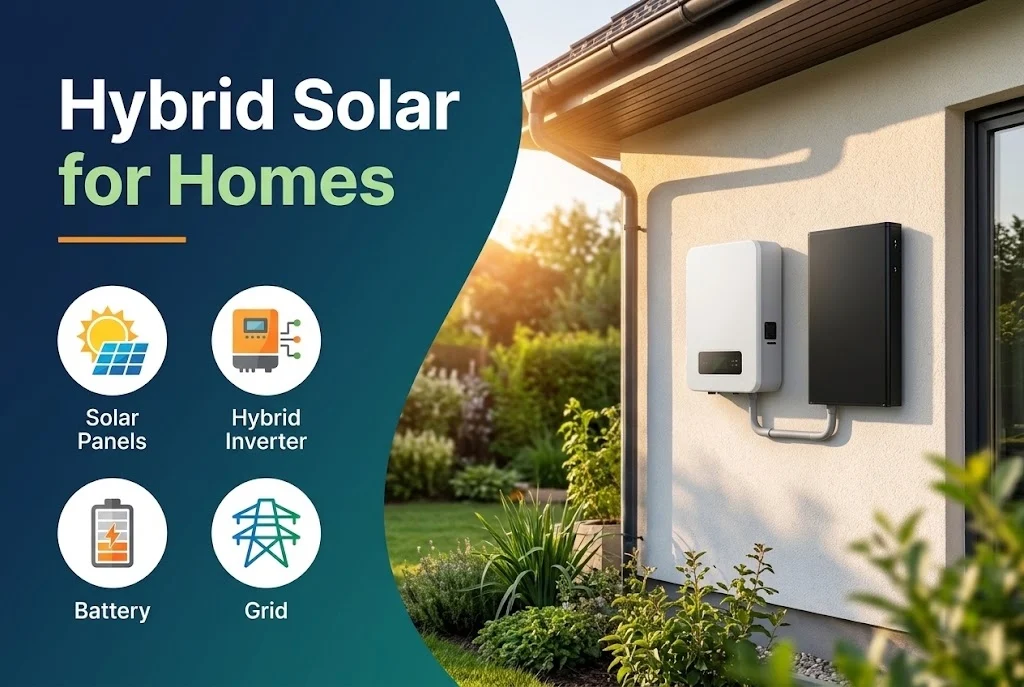
A hybrid solar system joins solar panels, a hybrid inverter, a battery and the utility connection in one setup. It uses solar power first, stores some of it in the battery and keeps chosen loads running when the utility fails.
It costs more than an on-grid system because of the battery and the more capable inverter, but it is the usual choice for homes that face regular power cuts.
Key takeaways
- One hybrid inverter manages the panels, the battery and the utility.
- The battery runs the backup loads when the utility fails.
- Only the loads on the backup circuit are backed up, not necessarily the whole house.
- Battery size follows from the backup loads and the hours you want.
How a hybrid system works
During the day the solar power runs your loads first. Extra power charges the battery, and when the panels make less than you use the missing power comes from the battery or from the utility, depending on the settings.
When the utility fails, the hybrid inverter separates the house from the grid and keeps the backup loads running from the panels and the battery.
Choosing the backup loads
Most homes put the loads they cannot do without on a separate backup distribution board fed by the inverter. Typical choices are:
- Lights, fans and the Wi-Fi router.
- A refrigerator and a television.
- Chargers for phones and laptops.
- Larger loads such as an air conditioner or a water pump only if the inverter and the battery are sized for them.
Sizing the battery
The battery has to supply the backup loads for the hours you want. Multiply the power of the loads by the hours to get the energy, then allow for the usable share of the battery and the losses. A battery with a larger usable capacity gives longer backup; a larger inverter lets you run more loads at once.
The battery must also suit the inverter, so the voltage and the type (lithium or lead-acid) are chosen together with it.
Hybrid or on-grid?
Choose on-grid if the utility supply is dependable and you want the lowest cost. Choose hybrid if outages are frequent or a few loads must always stay on.
Before you decide
- List the loads that must stay on and their power.
- Decide how many hours of backup you want.
- Check the roof space for the panels and the room for the battery, which needs a cool, ventilated place.
- Ask for a design with the backup circuit, the battery and the inverter sized together.
When to call us
Our engineers can list your loads, size the battery and the inverter and give you a quotation. Use the quote page, see our residential solar solutions, or look at the inverters and batteries we supply.

Leave a comment