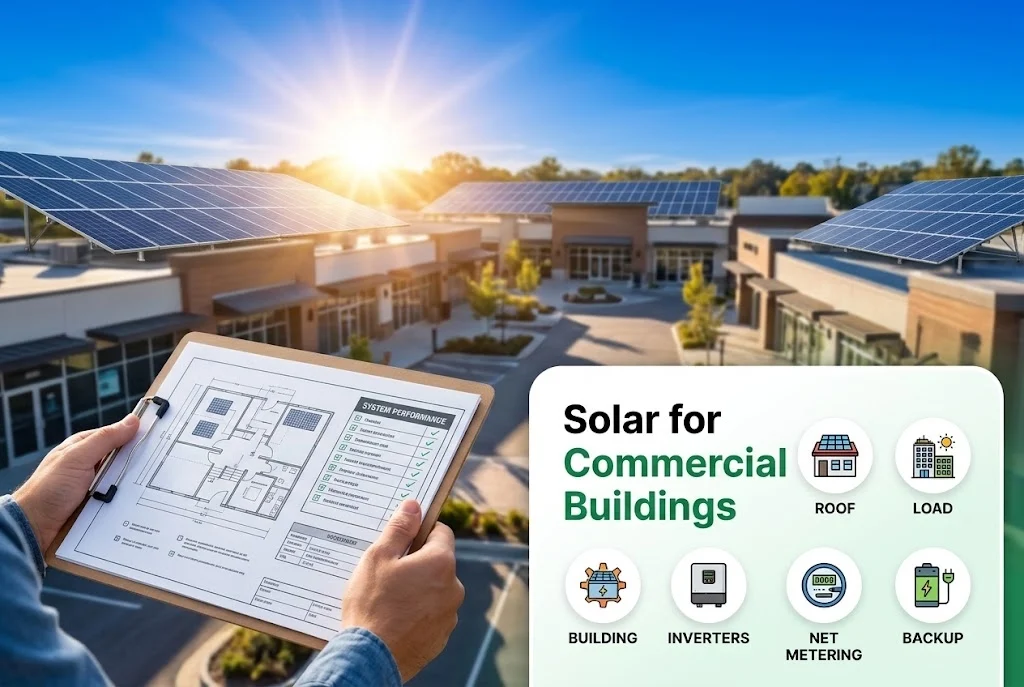
A shop, school, office block or clinic can save a lot with solar, because it uses power during the day when the sun is strongest. The principles are the same as for a home, but the scale, the structure and the paperwork are different. These are the points to plan.
Key takeaways
- Daytime use matches solar production well, which makes the savings clearer.
- The load profile, the roof and the supply connection decide the design.
- Three-phase supply, larger inverters and stronger protection are typical.
- Plan for access, safety, approvals and maintenance from the start.
1. Look at the load
Start with your bills and, if you have one, your demand data. How much do you use by day, and in which hours? A business that works from morning to evening can use most of its solar directly. See load profile and solar design.
2. The roof
Commercial roofs are often large and flat but crowded with equipment, tanks, lift rooms and air conditioners. Check the usable area, the strength of the roof and the waterproofing. Read rooftop structural check for solar and roof space needed for solar.
3. The supply connection
Most commercial buildings have a three-phase supply and a larger sanctioned load. The inverter or inverters must match; see single-phase vs three-phase. Net metering or export may need approval from the electricity company; read net metering in Pakistan.
4. System type
A grid-tied system gives savings. If outages are costly, a hybrid system with batteries or a link to a UPS or generator keeps the critical loads running; see solar with a diesel generator. Decide which loads are critical.
5. Safety and access
The roof needs safe access, edge protection and walkways for the installation and for cleaning. Fire safety and the position of isolators should be agreed with the building owner and, where needed, the authorities.
6. Ownership and tenancy
If you rent, check the lease, the owner's permission and what happens to the system if you move. Approval from the building owner is often the longest step.
7. Operation and maintenance
Plan cleaning, monitoring and a yearly service from the start; see annual solar plant service checklist.
Next step
Send us your bills and photographs of the roof through the quotation form, or read about our commercial solar solutions.
Leave a comment