
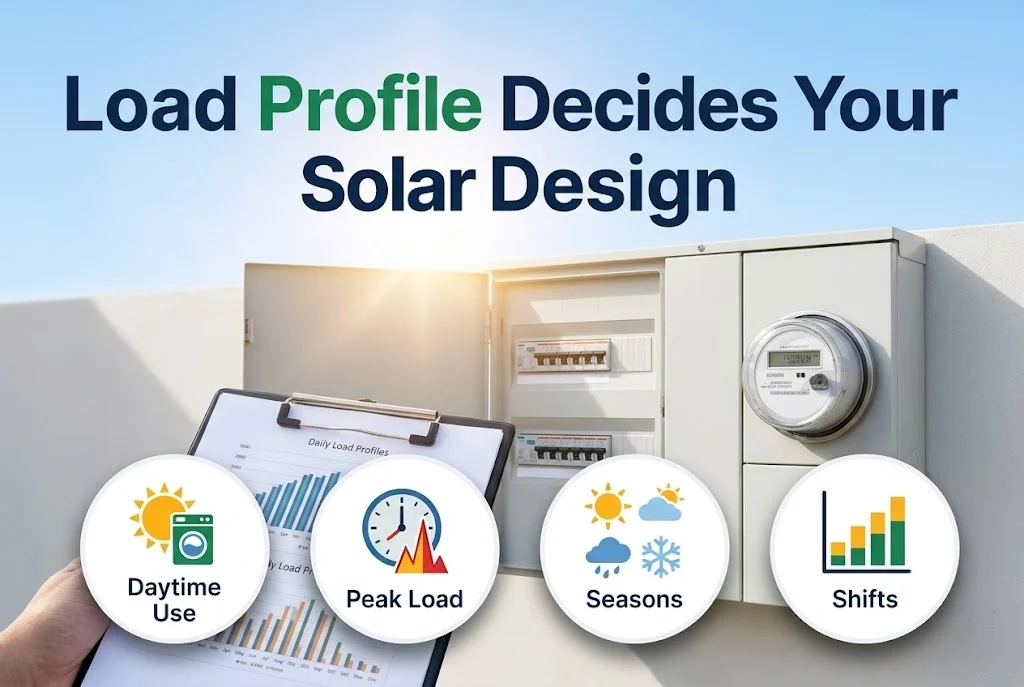
Two factories can use the same number of units a month and need completely different solar systems. The reason is the shape of their use through the day. This shape is the load profile, and it is the most useful piece of information for a commercial or industrial design.
Key takeaways
- A load profile shows how power use varies by hour of the day, and by day of the week and season.
- Solar produces in daylight, so the overlap between use and production decides how much is used directly.
- A profile with a high peak or a night load leads to a different design, perhaps with batteries.
- Data from a logger or a smart meter is far better than a guess.
1. What a load profile shows
It is a graph of power (kW) against time, for example in 15-minute steps, for a day, a week or a year. It shows when machines start, when the air conditioning comes on, and how much is constant (base load) and how much is variable.
2. How to get one
- A smart meter or a utility's data, if available.
- A power logger installed on the main incoming supply for one or two weeks.
- Records from your own plant control system.
Bills give only a monthly total, so a short logging period is worth the effort.
3. Matching solar to the profile
Solar output is zero at night, rises in the morning, peaks at noon and falls in the afternoon. If your load is high during those hours, most of the solar energy is used on site. If the load is mostly at night, a grid-tied system saves less, and the savings may depend on export rules or batteries.
4. Peak demand and tariff
Commercial and industrial tariffs may include charges based on the maximum demand. Solar helps in the daytime, but a peak at a cloudy moment or in the evening will not be cut. Batteries can help, but they add cost. See understand your electricity bill before you go solar.
5. Effect on the design
The profile helps you choose the size, the number and size of inverters, whether to use batteries, and how to split the loads between the grid, the solar and the generator. It also tells you if the system could be sized below the maximum roof area and still serve you.
6. Plan for change
If you plan to add machines or shifts, use a margin, or leave room to expand; see solar for factories.
Next step
We can log your load and use the data in the design; ask through the quotation form or read about our industrial solar solutions.


Leave a comment