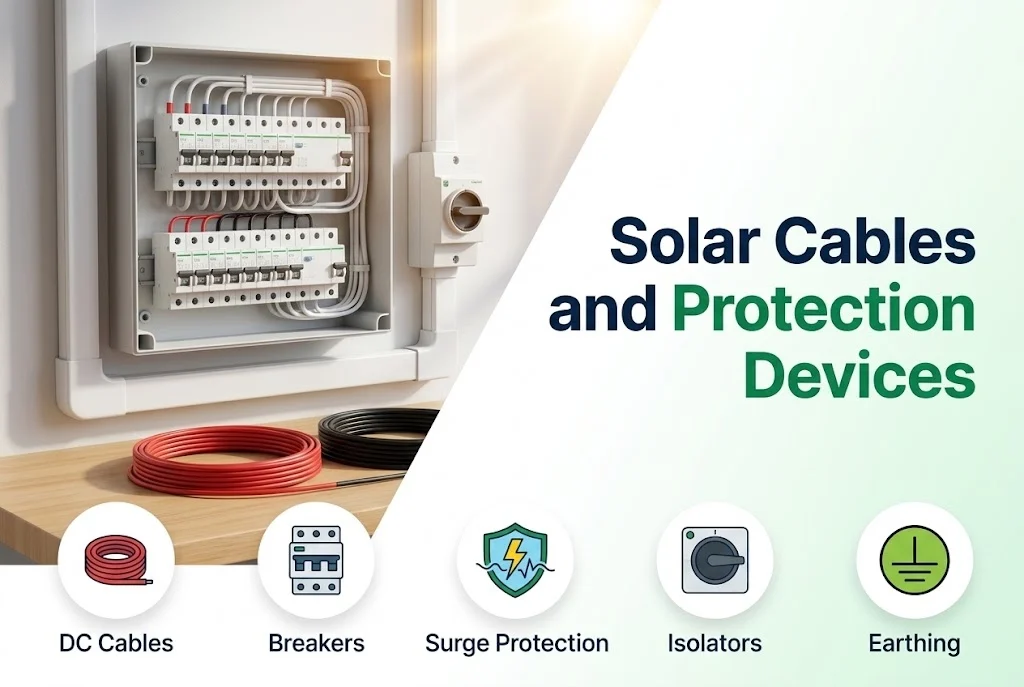
Panels and inverters get the attention, but safety and reliability depend on the small parts: cables, connectors, switches and protection. They are a small share of the cost and a large share of the risk if they are wrong. Here is what each does.
Key takeaways
- Use solar-rated, UV-resistant DC cable and matching connectors from the same maker.
- Size cables so the voltage drop is small and they do not overheat.
- The DC side needs DC-rated isolators and fuses; the AC side needs proper breakers.
- Surge protection and good earthing protect the inverter from lightning and switching surges.
1. DC cable and connectors
Solar DC cable has double insulation and is made to withstand sunlight, heat and moisture for decades. Panels come with short cables and connectors; the rest are joined with matching connectors. Mixing connector makes, or crimping them badly, causes heating and is a known cause of faults. Connectors must be fully pushed in and not left under tension.
2. Cable size
A cable that is too thin heats up and wastes power as voltage drop. The designer chooses the size from the current and the length of the run, keeping the loss low, usually in the range of one or two per cent. The same goes for the AC cable to the board. Cheap cables with less copper than the label claims are a risk, so ask for the brand and specification.
3. Isolators, fuses and breakers
A DC isolator lets the DC side be switched off safely. Where strings are connected in parallel, string fuses protect against reverse currents. On the AC side, a breaker protects the cable and the inverter. All of these must be rated for the voltage and current, and for DC where applicable. See DC and AC in a solar system.
4. Surge protection
Lightning and switching surges can travel along cables and damage electronics. Surge protective devices (SPDs) on the DC and AC sides divert the surge to earth. They only work if the earthing is good. Read solar earthing and lightning protection.
5. Labels and neatness
Cables should be tied up, kept off sharp edges and hot surfaces, run in conduit or trays where needed, and labelled. Neat work is not a cosmetic matter; it makes faults easier to find and prevents damage.
6. A short checklist for the quotation
- DC cable type and size, AC cable type and size.
- Connector make.
- DC isolator, fuses and AC breaker ratings.
- Surge protection on both sides.
- Earthing arrangement.
Next step
If you have a system already and are unsure about the protection, we can inspect it; see our maintenance service or use the contact page.
Leave a comment