
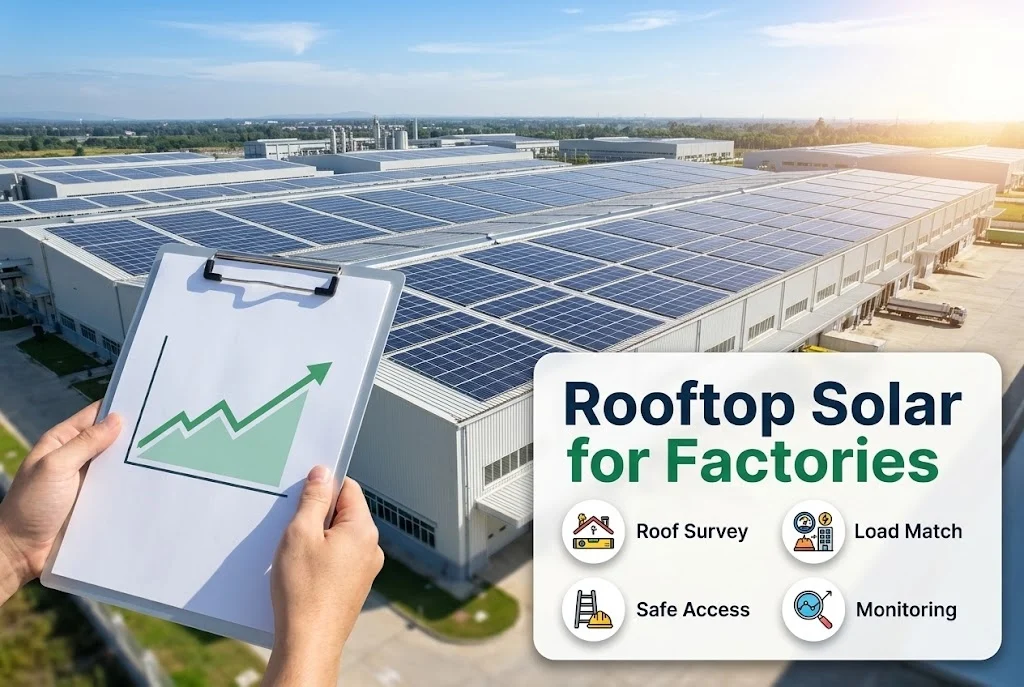
A factory roof can provide valuable space for solar generation, often close to the equipment that consumes electricity during the day. A rooftop solar plant may reduce grid imports, but industrial roofs differ from residential roofs in structure, access, electrical infrastructure and operating risk. The project should be planned as an industrial electrical and structural installation.
Rooftop solar for factories starts with a site survey and load analysis. The designer must understand the roof construction, building condition, shading, daytime demand, electrical connection and facility operating schedule. This guide explains the main considerations for factories, mills, warehouses and cold storage facilities.
Key points
- Review roof type, condition, structural capacity and wind loads.
- Use interval demand and operating schedules to size the system.
- Choose mounting methods that suit the roof and preserve waterproofing.
- Coordinate inverter connection with switchgear, transformers and generators.
- Plan access, safety permits, shutdowns, commissioning and maintenance.
1. Start with the factory’s electricity demand
Collect recent electricity bills and interval demand data where available. Monthly units alone do not show when a factory uses power or how its demand changes during production shifts. A load profile helps identify the overlap between solar generation and site consumption.
List major loads such as motors, compressors, pumps, chillers, production lines and lighting. Record their ratings, operating hours and starting characteristics. If a new line or expansion is planned, include it in the design assumptions rather than relying only on historic consumption.
2. Identify the roof construction
Industrial buildings may have reinforced concrete roofs, metal sheets, insulated sandwich panels or other lightweight structures. The mounting method depends on the roof material and its supporting members. A metal roof sheet may not be designed to carry the array directly; loads may need to transfer to purlins or other structural elements.
Record roof type, support spacing where accessible, slope, age and condition. Identify fragile roof lights, ventilation openings, skylights and rooftop equipment. The survey should also consider whether the roof is under warranty and whether penetrations are permitted.
3. Verify structural capacity
The solar array adds permanent equipment loads and wind creates uplift and lateral forces. The structural assessment should consider modules, rails, clamps, cable trays, walkways and any ballast or additional supports. Roof edges and corners may experience different wind forces from central areas.
Older, lightweight, modified or damaged roofs may require a structural engineer’s written assessment. Do not assume that a roof is suitable based on appearance or a generic panel weight estimate. The mounting system and building structure must be reviewed together.
4. Select a suitable mounting system
Mounting systems for concrete roofs, metal sheet roofs and sandwich panels use different fixing approaches. The selected structure must suit the roof profile, supporting members, module clamp zones and wind exposure. Material grade, coating, fasteners and corrosion resistance should be specified.
Roof penetrations must preserve waterproofing. Non-penetrating or ballasted arrangements also need structural review because they can create concentrated loads and have their own wind-resistance requirements. Ask for the mounting design and installation details before approving the project.
5. Plan panel layout and maintenance access
Measure usable roof area and mark tanks, vents, skylights, parapets, drains and mechanical equipment. Consider shading from nearby buildings, stacks and rooftop structures throughout the day and year. The layout should preserve access routes and allow technicians to inspect the array.
Do not maximise panel count by blocking roof drains, fire access or essential maintenance paths. Industrial sites need clear routes to HVAC equipment, ventilation and other plant. Cable routes should be organised and protected against mechanical damage.
6. Match the solar plant to the electrical system
Review the facility’s single-line diagram, transformer, main switchgear, distribution boards and connection points. Confirm the supply voltage, phase arrangement, available capacity and protection requirements. Larger sites may need additional metering, switchgear or cable work to connect the PV plant safely.
Check existing power factor correction, harmonic filters, UPS systems and generators. These can affect the connection design and operating strategy. If power quality is a concern, measurement may be needed before selecting the inverter and protection arrangement.
7. Select panels and inverters
Panel selection should consider rated power, dimensions, temperature coefficient, mechanical ratings and warranty terms. The inverter must match the array voltage and current, AC output, MPPT arrangement and environmental conditions. String design should account for cold-weather Voc and the inverter’s maximum input current.
Different roof orientations or shading patterns may need separate MPPT inputs. The design should show the number of modules per string, tracker assignment and protective devices. Ask for exact model numbers and datasheets rather than a generic product description.
8. Decide whether batteries are required
A grid-connected rooftop solar system can reduce daytime grid consumption but normally does not provide backup during a utility outage. If the factory needs backup, identify the critical loads and decide whether a hybrid inverter, battery system, UPS or generator integration is appropriate.
Battery energy capacity and power capability must both be considered. A large battery in kWh may still be unable to start a motor if the inverter cannot deliver the required surge. For many factories, a battery may be intended for controls and critical circuits rather than the full production load.
9. Plan installation around production
Coordinate material delivery, lifting, roof access, electrical shutdowns and work permits with facility management. Factories may require safety induction, work-at-height controls, restricted work hours and coordination with production teams. Identify overhead lines, fragile surfaces, moving equipment and vehicle routes.
Agree the shutdown window and isolation responsibilities before electrical work begins. Keep fire routes, roof drains and access to existing plant clear. The project schedule should include testing and commissioning, not just panel installation.
10. Commissioning and handover
Commissioning should verify the installed array and inverter against the approved design. Checks may include string polarity and voltage, insulation testing where appropriate, earthing, protection, AC connection, inverter settings and monitoring. The exact tests depend on the system and applicable requirements.
At handover, the facility should receive as-installed drawings, equipment schedules, serial numbers, test records, manuals, warranties and safe shutdown procedures. Facility staff should know how to review alarms and contact the service provider.
11. Maintenance for industrial rooftop systems
Maintenance may include reviewing energy data, inspecting accessible mounting components, checking cable supports and enclosures, reviewing inverter alarms and assessing electrical protection. Panel cleaning should be based on site soiling and safe access. Industrial dust, fumes and bird activity may affect cleaning requirements.
Keep inspection reports and compare generation under similar conditions. Repeated low output or alarms should be investigated rather than automatically replacing components. Maintenance work should be coordinated with site safety and operating procedures.
12. Information needed before a factory solar quotation
- Electricity bills and interval load data.
- Roof drawings, construction details and known structural issues.
- Single-line diagram, transformer and switchgear details.
- Major equipment list and factory operating schedule.
- Generator, UPS and battery information.
- Roof access, safety and shutdown requirements.
Factory rooftop solar across Pakistan
Atiq Traders provides solar system design, supply, installation, commissioning and after-sales support for factories, mills, warehouses and cold storage facilities across Pakistan. The recommended plant depends on roof conditions, load profile, electrical infrastructure and operating priorities.
To arrange an industrial site assessment or quotation, use the quotation form or contact us through the contact page. You can also explore our solar solutions, installation services and maintenance services.


Leave a comment