
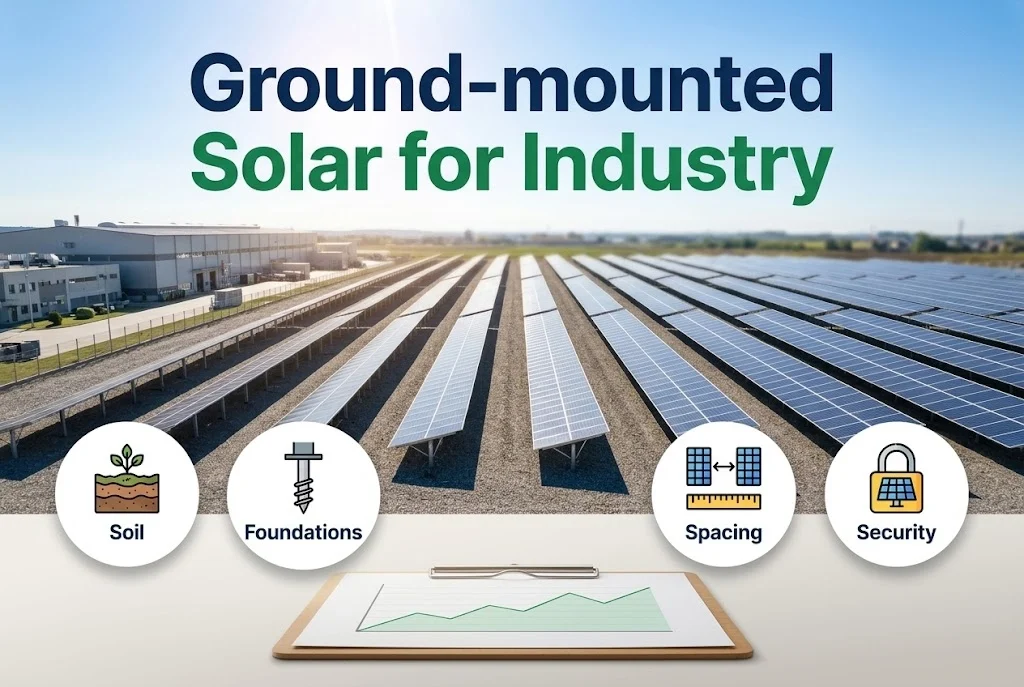
Where the roof is too small, too weak or too shaded for the power a plant needs, panels can be placed on structures on open land. A ground-mounted system can be larger, is easy to reach and can be built to a clean, regular layout.
It also brings its own questions about land, foundations, fencing and cable length.
Key takeaways
- Ground mounting suits plants with spare land and a large load.
- Foundations are chosen from the soil and the wind.
- Row spacing avoids shade from one row on the next.
- Drainage, fencing and security are part of the design.
Land and soil
The land should be level or easy to level, free of shade from buildings and trees, and not liable to flooding. A soil test shows what foundations the structures need: concrete footings, driven piles or screw piles. Clay, sand and rock all behave differently.
Layout
- Rows run in the same direction and face the sun at the same tilt.
- Spacing between rows is set so that one row does not shade the next in the morning and afternoon.
- Paths between the rows allow people and, where needed, a cleaning vehicle to pass.
- The inverters are placed to keep cables short and in the shade.
Cables, drainage and security
Longer cable runs lose more power, so the cable size is chosen with the distance in mind, and cables are buried or carried in trays and protected from damage. Rain water must run off without washing out the foundations. A fence, lighting and, where needed, cameras keep the plant safe.
Roof or ground?
If a roof can take the system it is usually the simpler choice, see rooftop solar for factories. Ground mounting is the answer when the roof cannot, or when the plant wants to grow beyond it.
When to call us
Tell us about your land and your load and we will say whether a ground-mounted plant suits you. Use the quote page, see our industrial solar solutions, or look at the mounting structures we supply.


Leave a comment