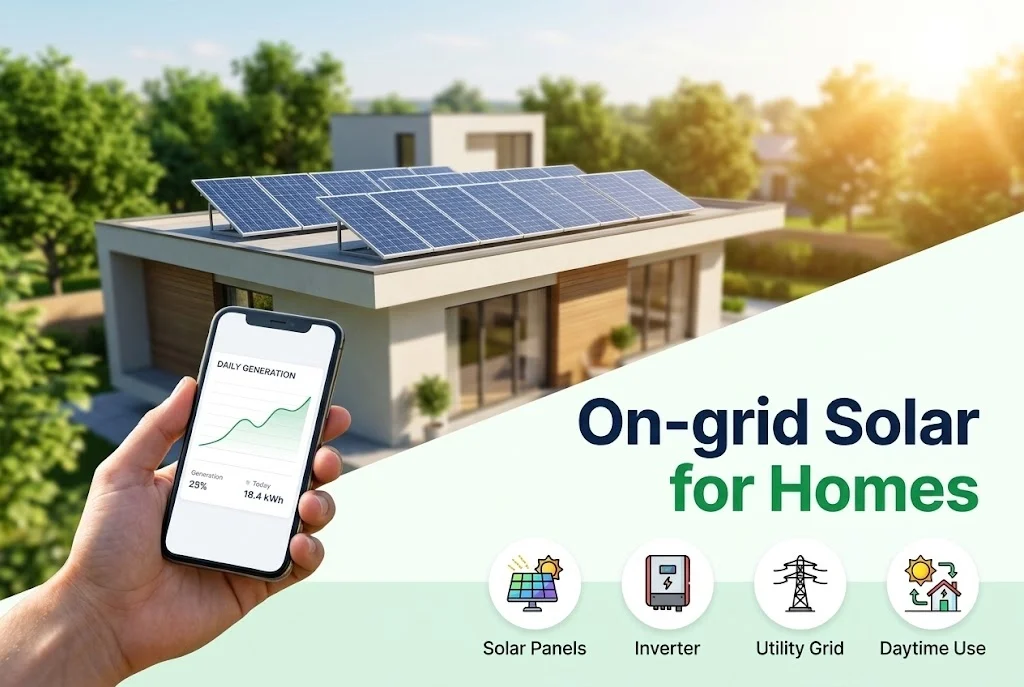
An on-grid (grid-tied) solar system makes electricity on your roof and feeds it into your home’s wiring alongside the utility supply. It is the simplest and usually the lowest-cost type of home solar, because it needs no batteries.
It suits a home with a fairly dependable utility connection and most of its use in the daytime. This guide explains the parts, how the system behaves and what to check before you choose it.
Key takeaways
- An on-grid system is made of panels, an inverter and the utility connection; it has no batteries.
- Your loads take solar power first and the utility supplies the rest.
- By design it switches off when the utility fails, so it gives no backup in a power cut.
- It suits homes with a dependable supply and daytime use.
How an on-grid system works
The panels make direct current (DC). The grid-tie inverter turns it into alternating current (AC) at the same voltage and frequency as the utility and keeps it in step with the utility supply.
Power goes to the loads in your home first. Anything extra flows to the grid where the utility’s rules and meter allow it, and when the panels make less than you use, for example at night or under cloud, the utility supplies the difference.
What the system is made of
- Solar panels on the roof or on a mounting structure.
- An on-grid inverter.
- DC and AC cables with protection devices such as breakers and surge protection.
- Earthing for the structure, the panels and the inverter.
- The meter arrangement required by the utility.
Why it stops during a power cut
A grid-tied inverter is built to shut down when the utility supply is lost, so that no power is pushed into lines that workers may be repairing. The panels can be in full sun while the house has no power.
If you need power during outages, look at a hybrid system or at solar with battery backup.
Who it suits
- Homes whose utility supply is on for most of the day.
- Households that use most of their power in the daytime.
- Roofs with free space, a good direction and little shade.
- Households happy without backup, or with a separate UPS or generator for outages.
What to check before you decide
- Look at your monthly bills to see how many units you use.
- Check the roof for space, direction, shade and strength.
- Ask about the utility’s rules for connecting and metering a solar system, because they decide how extra power is handled.
- Decide whether you need power during outages; if you do, choose a hybrid system.
When to call us
If you are thinking about solar for your home, our engineers can visit, check the roof and the electrical connection and recommend a system. Ask for a quotation on the quote page, read about our residential solar solutions, or see the solar panels and inverters we supply.
Leave a comment