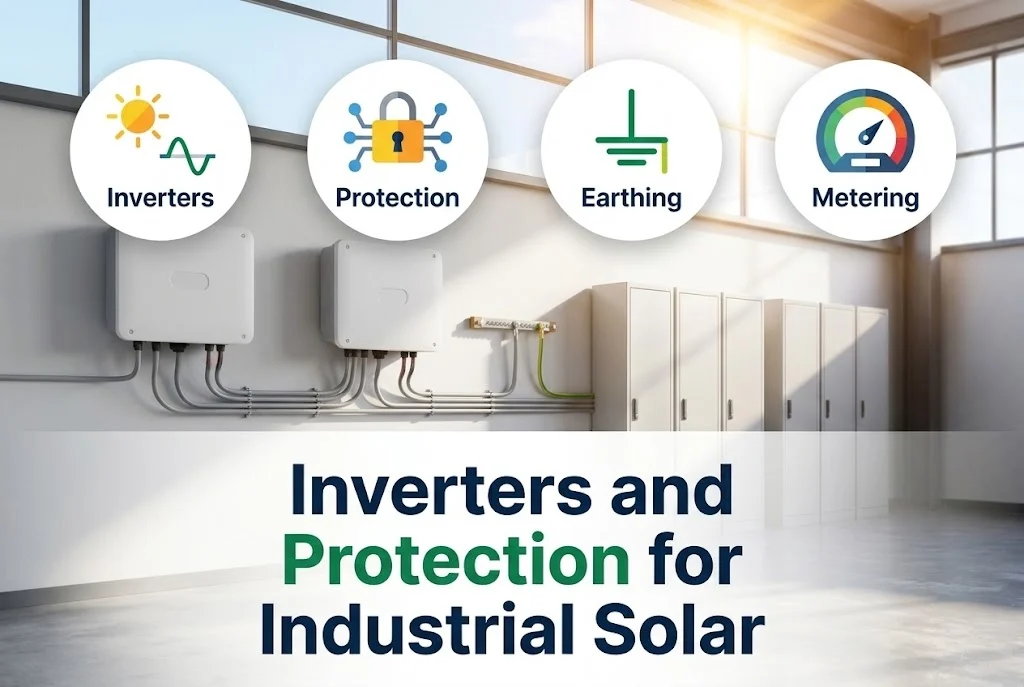
The panels make power, but the inverters and the protection devices are what make that power safe and usable for a plant. In an industrial system they are designed together with the array, not chosen afterwards.
This guide explains each part in plain terms.
Key takeaways
- Three-phase inverters connect the plant to the factory’s supply.
- DC isolators, breakers and surge protection protect people and equipment.
- Earthing ties everything to one safe reference.
- Metering and monitoring show what the plant produces.
The inverters
Industrial plants usually use three-phase inverters. Several string inverters spread over the array are common, because a fault in one affects only part of the plant and they are easy to replace. Larger plants may use bigger central inverters. The choice depends on the size, the layout and the service arrangements.
Protection devices
- DC isolators and fuses or breakers on the panel side of the inverters.
- AC breakers and, where required, protection relays on the supply side.
- Surge protection devices on the DC and AC sides against lightning and switching surges.
- Residual-current and insulation monitoring as the design requires.
Earthing and lightning
The structures, the panel frames, the inverters and the cabinets are bonded together and connected to the earth system, which is tested after installation. Earthing lowers the risk of shock and gives surge protection a path to work. Where lightning protection already exists on the building, the solar earthing is joined to it properly.
Metering and monitoring
A meter records the energy that the plant produces and the energy exchanged with the utility, and a monitoring system shows the output of each inverter. Falls in output are then seen early, which keeps the plant earning.
When to call us
Our engineers design the inverters, the protection and the earthing together with the array. Use the quote page, read about industrial solar, or see the inverters we supply.
Leave a comment