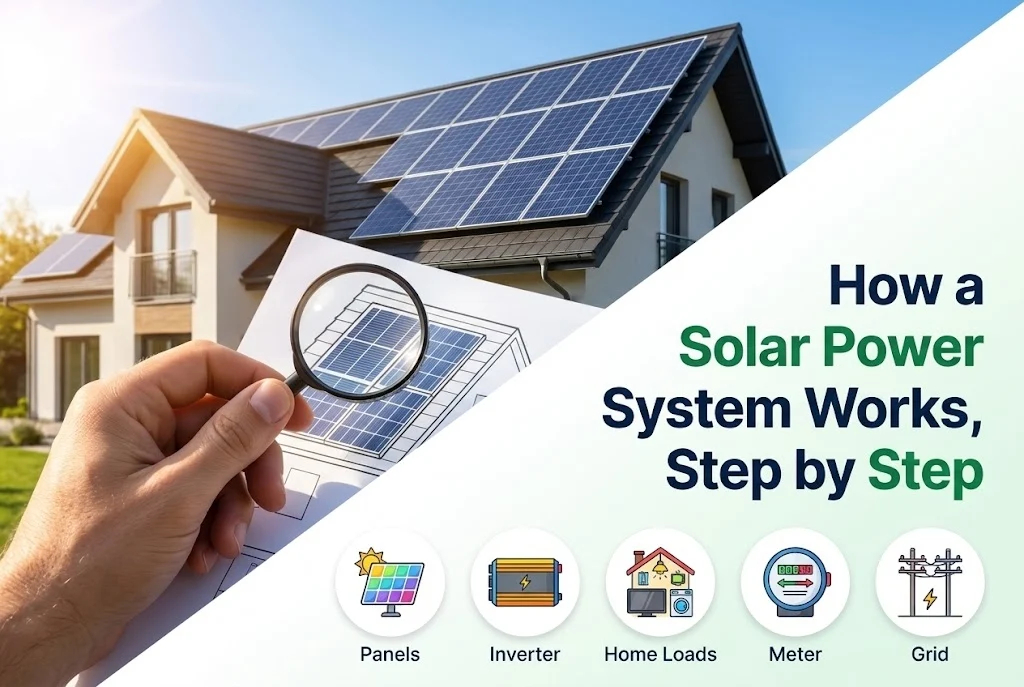
A solar system looks simple from the street: panels on the roof and a box on the wall. Inside, there is a clear chain of steps that turns sunlight into power you can use. Knowing the chain helps you read a quotation, ask better questions and spot problems early.
Key takeaways
- Panels make direct current (DC) when light falls on them; the inverter turns it into alternating current (AC) for your home or factory.
- A system is more than panels: mounting, cables, protection, earthing, the inverter and often a meter or battery.
- The type of system (on-grid, hybrid or off-grid) decides what happens to extra power.
- Every part has a limit, so the parts must be chosen to match each other.
1. Sunlight becomes DC power
Solar panels contain cells that release electrons when light hits them. Many cells are wired together in a panel, and many panels are wired together in groups called strings. The result is direct current at a voltage that rises and falls with the light, so output is highest on a clear day around midday and lower in cloud, haze or at dawn and dusk.
2. Cables and protection carry the DC to the inverter
Special solar cables, built to resist sunlight and heat, carry the DC power from the roof to the inverter. Along the way there are connectors, a DC isolator (a switch for safe shutdown) and surge protection. These parts are small and cheap compared with the panels, but they decide how safe and reliable the system is. We explain them in solar cables and protection devices.
3. The inverter makes usable AC
Homes and factories run on AC, so the inverter converts the DC. A good inverter also tracks the best operating point of the panels many times a second (this is called MPPT, covered in what MPPT is), watches the grid, shuts down safely if something is wrong and reports the data you see in the app. Different types exist; see our solar inverter guide.
4. Power goes where it is needed
The AC output joins your electrical board. Your loads use the solar power first. What happens to any surplus depends on the system:
- On-grid: the surplus can be exported to the grid where the rules allow it, for example under net metering.
- Hybrid: the surplus charges a battery, and the battery supplies the loads when the grid or the sun is not available.
- Off-grid: there is no grid at all, so the battery and the panels must carry everything.
The comparison of on-grid, hybrid and off-grid systems helps you decide which one fits.
5. Metering, monitoring and the grid
If you export power, a meter records what you send and what you take. Most inverters also send data to an app, so you can see daily production and spot a drop early. See what to watch every week.
6. Why the parts must match
Panels, inverter, cables and breakers all have voltage and current limits. An inverter that is too small wastes panel power; one that is too large costs more than it needs to. A mismatch in voltage can switch the inverter off on a hot day. This is why a proper design, not just a list of parts, is what you are paying for.
Next step
If you would like a system designed around your own bills and roof, send us your details through the quotation form or read how we work on the services page.
Leave a comment