
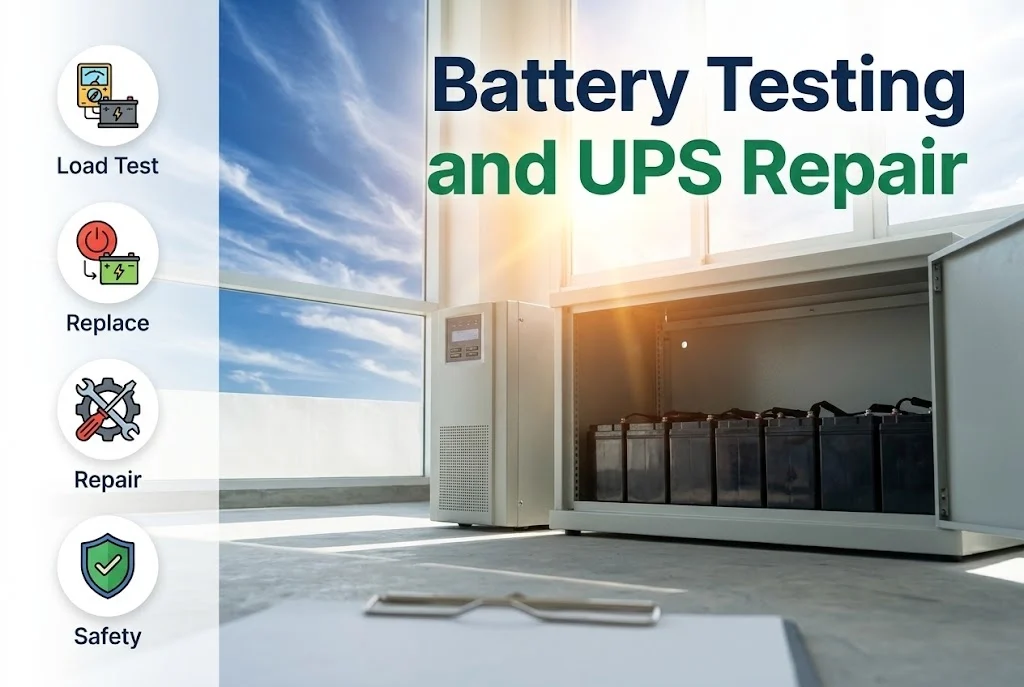
In a UPS or a solar battery system, the battery is the part that wears out and the electronics are the part that fail. Most calls we receive about a UPS that gives short backup, beeps or does not start turn out to be one of these two.
Testing tells us which.
Key takeaways
- Batteries are tested under load, because voltage alone can mislead.
- A weak battery in a bank affects the others, so the bank is looked at as a whole.
- UPS faults often lie in the battery, a fan, a fuse or the charger.
- Safe handling matters: batteries and UPS units hold stored energy.
Testing the batteries
We measure each battery’s voltage, check the terminals and the case, and apply a load to see how it holds up. A battery can show a good voltage with nothing connected and still collapse under load. The result tells us whether it can be kept or must be replaced.
Replacing batteries
Batteries are replaced with the same voltage and type that the system is made for, and, in a bank, all together, so that new and old do not work against each other. The terminals are cleaned and tightened and the charger settings are checked.
UPS repair
- No power or no start: check the input supply, fuses and breakers.
- Short backup or beeping: test the batteries.
- Overload alarm: check the load against the rating.
- Overheating or noise: clean the vents and check the fans.
- Faults on the control board or the inverter stage: repair or replace the module, depending on availability.
Staying safe
A UPS contains stored energy even when it is switched off and unplugged, and batteries can give a severe shock or burn if shorted. Please do not open them. We follow the proper procedures, and prevent repeat faults with regular checks, see maintenance checks.
When to call us
If your UPS or battery system is not giving the backup it should, we can test it and repair it. Use the contact page, see our repair services, or look at the batteries and UPS systems we supply.

Leave a comment