
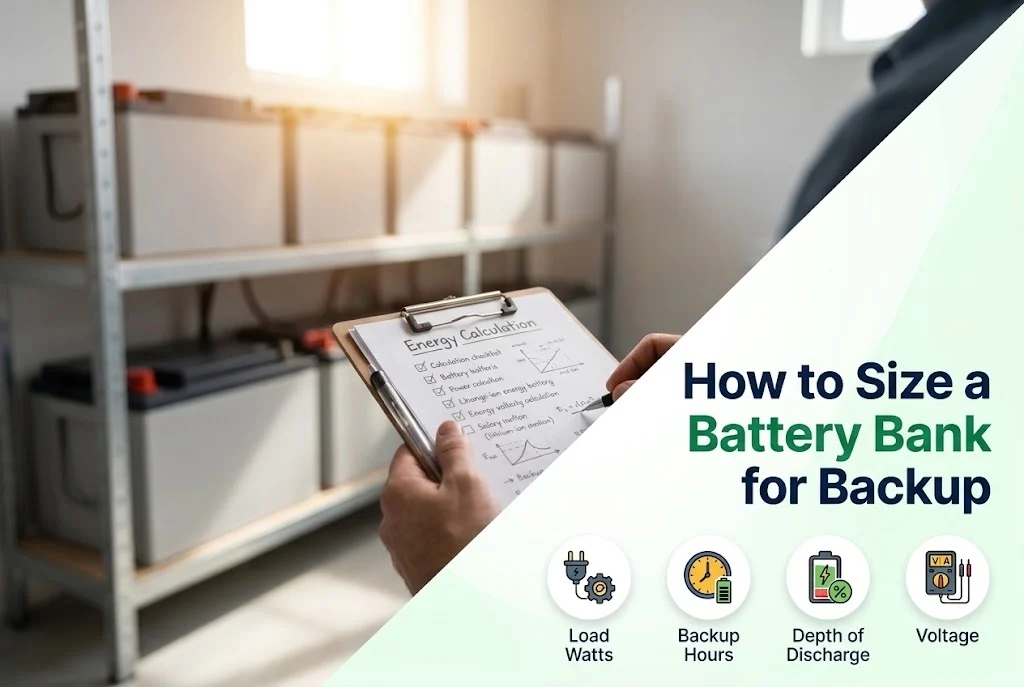
"How many batteries do I need?" is a question with a simple method behind it. You need to know what you want to run, for how long, and what type of battery you will use. The numbers below are examples; use your own.
Key takeaways
- Energy needed (Wh) equals the load (W) multiplied by the hours of backup.
- Add the inverter loss, and divide by the usable share of the battery, which depends on the chemistry.
- Convert to amp-hours at the battery voltage to compare with batteries.
- Check that the battery and inverter can supply the peak current of your loads.
1. List the loads
Write down each appliance that must run during an outage and its power in watts. Estimate how long each runs. Fans, lights, a fridge, a router and a television are typical. Air conditioners and pumps are large and start with a surge.
2. Calculate the energy
Multiply the power by the hours for each load and add them up. For example, 1,000 W running for 4 hours is 4,000 watt-hours (Wh), or 4 kWh.
3. Add inverter losses
Inverters lose some energy, about 10 per cent. Divide the energy by 0.9: 4,000 ÷ 0.9 gives about 4,450 Wh from the battery.
4. Allow for depth of discharge
You should not use all of a battery. Lithium (LiFePO4) batteries are often used down to 80 per cent or more of their rated capacity; lead-acid batteries are usually limited to about 50 per cent for a long life. See depth of discharge and battery life.
- Lithium at 80 per cent usable: 4,450 ÷ 0.8 is about 5,560 Wh.
- Lead-acid at 50 per cent usable: 4,450 ÷ 0.5 is about 8,900 Wh.
5. Convert to amp-hours
Divide the energy by the battery voltage. At 48 V: 5,560 ÷ 48 is about 116 Ah (lithium) and 8,900 ÷ 48 is about 185 Ah (lead-acid). Real batteries come in fixed sizes, so choose the next size up, and add margin for ageing and for cold or hot weather.
6. Check the peak current
A 4,000 W load at 48 V draws more than 80 A from the battery. Check the battery's maximum discharge current and the inverter's rating. A motor load with a large start surge may need a bigger inverter and a stronger battery than the energy calculation alone shows.
7. Plan for the grid and the sun
If the sun and the grid both charge the battery each day, a smaller bank may do. If you want several days of autonomy, multiply the energy. Our guide on choosing a hybrid inverter and lithium vs lead-acid give more background.
Next step
List your loads and the hours you need, and send them through the quotation form; we will size the bank and the inverter for you.
Leave a comment