
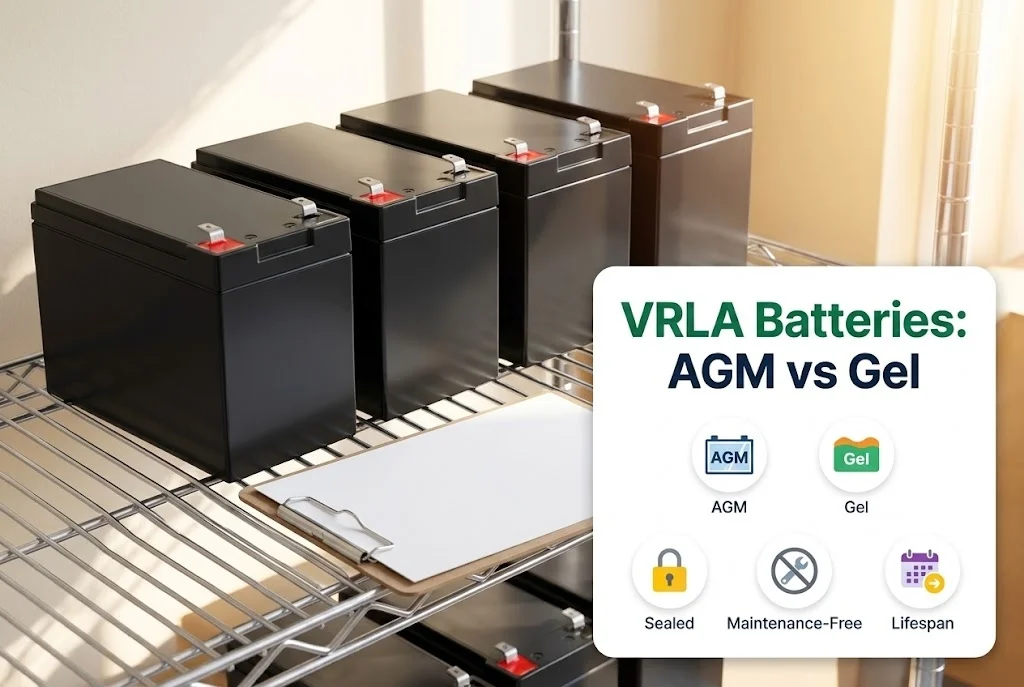
Valve-regulated lead-acid (VRLA) batteries are sealed and need no topping up with water. They are widely used in UPS systems, telecoms and solar. Inside, there are two main designs: absorbed glass mat (AGM) and gel. They look alike, but they behave differently.
Key takeaways
- AGM batteries hold the electrolyte in glass mats and give high current easily, which suits UPS and short, heavy loads.
- Gel batteries hold it in a gel and tend to do better with deep cycling and heat.
- Both need correct charging, a cool room and regular checks.
- Always check the datasheet for the design life, the cycle life and the float voltage.
1. What "valve-regulated" means
The cells are sealed, and a one-way valve opens only under excess pressure. Gas that forms is mostly recombined inside, so you do not add water. They still need ventilation, since gas can escape under overcharge. See battery safety: ventilation and protection.
2. AGM: strengths
AGM batteries have low internal resistance, so they can deliver large currents for short periods. This makes them well suited to UPS systems, where the battery must carry the load for minutes at a high rate. The Narada Eos-2000 2 V cell is an example of an AGM VRLA design for telecoms, UPS, utilities and solar.
3. Gel: strengths
Gel batteries tend to cope better with repeated deep discharge and hot conditions, and are often chosen for solar and long-duration backup. They usually accept charging currents less readily and must be charged at the voltage the maker states. The Narada MPG 12 V 200 Ah uses gel electrolyte.
4. Choosing between them
- UPS with short, heavy loads: AGM is common.
- Solar and long, deep cycles: gel, tubular or lithium may be better.
- Hot rooms: look at the heat rating and design life; see temperature and battery life.
5. Charging and care
Use a charger or inverter set to the battery maker's float and charge voltages, with temperature compensation if available. Avoid mixing old and new batteries. Check voltage, temperature and connections regularly, and do not leave them deeply discharged.
6. Design life
A design life of 10 or 12 years at 25 °C is a rating under good conditions. Heat shortens it. See when to replace a UPS or solar battery.
Next step
Tell us your use and room conditions and we will suggest the battery type through the quotation form, or see the batteries on our products page.

Leave a comment