
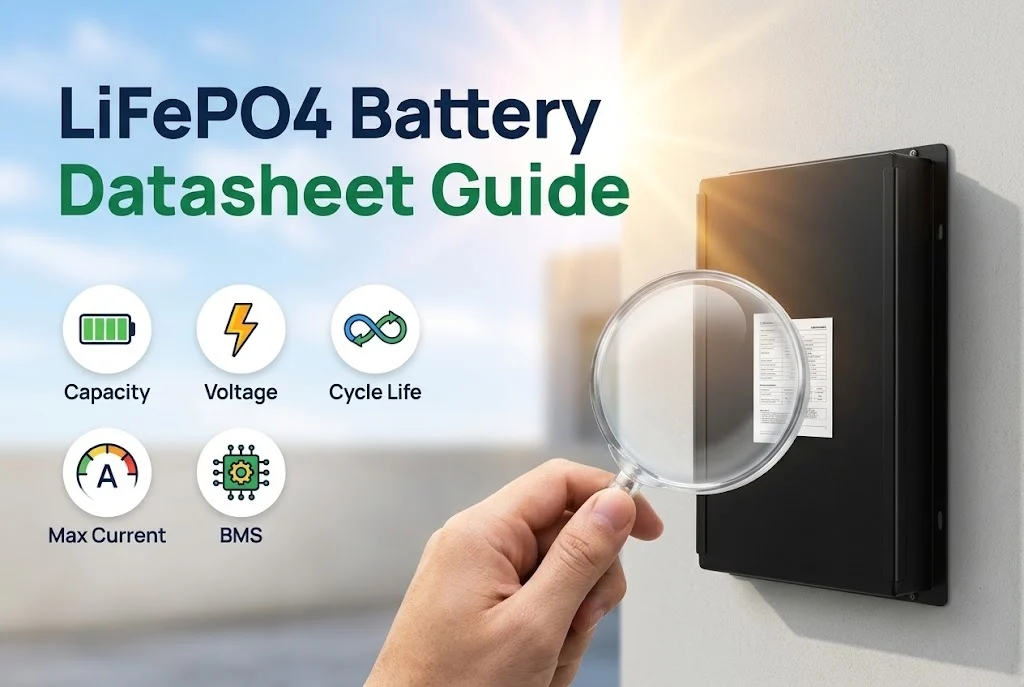
Lithium iron phosphate (LiFePO4) batteries are now a common choice for home and business storage. Their datasheets look similar, but the details differ. Here is how to read one, using the types of figure you will find.
Key takeaways
- Nominal voltage and capacity (Ah) give the energy in kWh; check the usable energy.
- Charge and discharge current limits must match the inverter.
- Cycle life must be read with its DoD, temperature and end-of-life condition.
- The BMS, communication and temperature limits decide whether it will work safely in your system.
1. Voltage, capacity and energy
A LiFePO4 cell is about 3.2 V, and a typical 48 V class battery has 16 cells in series for 51.2 V nominal. Multiply the nominal voltage by the capacity in amp-hours to get the energy. For example, the datasheet of the Greenage GVEs-51.2 battery lists 51.2 V and 430 Ah, which is 22 kWh. Also check the usable energy, which can be less than the nominal.
2. Charge and discharge current
The maximum continuous and peak currents tell you how much power the battery can deliver. The inverter must not ask for more than the battery can give, and the charge current should be within what the battery allows. Check these against the inverter datasheet; see choosing a hybrid inverter.
3. Cycle life
Look for the number of cycles, the depth of discharge, the temperature and the remaining capacity at the end of life. A figure at 25 °C and a given DoD is typical. Real life depends on how it is used. See depth of discharge and battery life.
4. Battery management system
The BMS protects the battery from over-charge, over-discharge, over-current, short circuit and high or low temperature, and balances the cells. Check what it protects against, and whether it communicates with the inverter, for example by CAN or RS485, so the inverter knows the battery's state.
5. Temperature ranges
Lithium batteries often have different temperature ranges for charging and for discharging; charging in the cold is usually restricted. Check both, and the recommended operating range. Hot rooms shorten life; see temperature and battery life.
6. Physical and safety items
Check weight, dimensions, the type of terminals, the protection rating, and any safety standards and certificates. Check also the warranty, including how many years and any throughput limit in kWh. Safe handling is covered in battery safety: ventilation and protection.
Next step
Send us the datasheet of any battery you are considering and we will check it against your inverter; or ask for a recommendation through the quotation form.


Leave a comment