
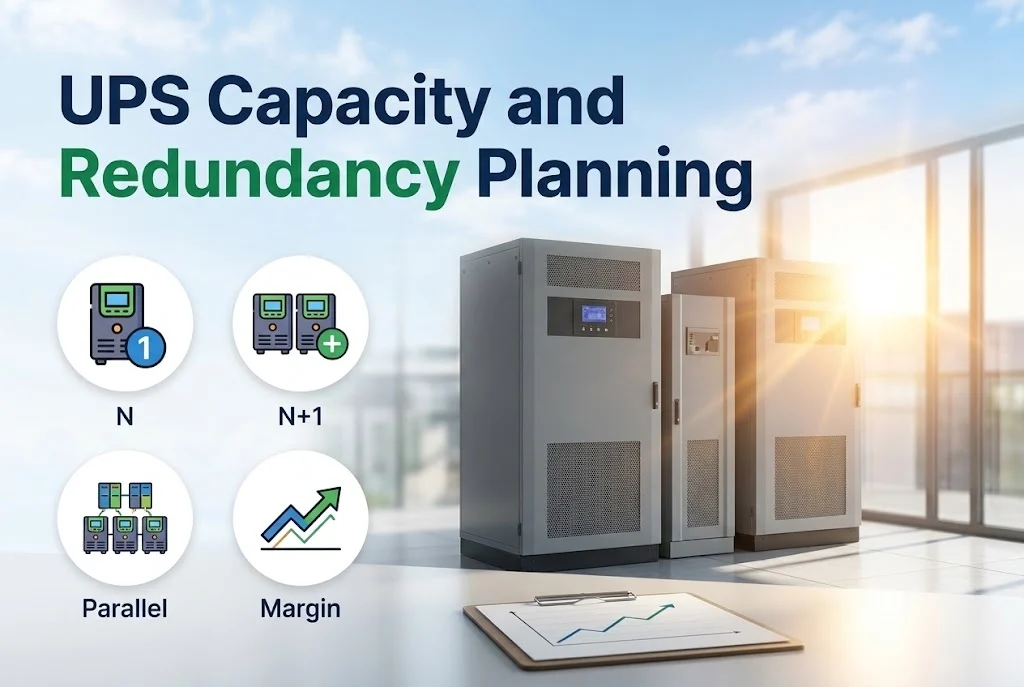
Two questions shape an industrial UPS design: how big must it be, and what happens if a UPS itself fails? The first is capacity and the second is redundancy.
Getting them right is cheaper than fixing a failure of a critical system afterwards.
Key takeaways
- Capacity is set from the measured critical load plus a margin for growth.
- N means exactly enough UPS capacity; N+1 adds one spare unit.
- Parallel UPS units share the load and can carry it if one fails.
- Redundancy costs more and is chosen by the cost of a stoppage.
Sizing the capacity
We start from the real load: measured if possible, otherwise added up from the equipment. The UPS must be rated for that load in both VA and kW, with a margin for growth and for the starting currents of equipment, and with the power factor of the load in mind. A UPS that runs near its limit has no room to cope with extra load or with age.
What redundancy means
- N: exactly enough capacity for the load. If the UPS fails, the load goes to bypass.
- N+1: one more UPS module or unit than needed, so that one can fail or be serviced and the load stays protected.
- 2N: two complete, separate systems, each able to carry the load, for the most critical sites.
Parallel UPS units
Two or more UPS units of the same size can be connected in parallel to share the load. If one fails or is switched off for service, the others carry the load, provided that the remaining units are large enough. Parallel units also let you add capacity later by adding a unit.
Choosing the level
The right level depends on what a stoppage costs: lost production, spoiled stock, safety or data. We look at that with you, and set the capacity and the redundancy together with the UPS type, see three-phase online UPS for industry.
When to call us
Give us your critical load and your tolerance for a stoppage, and we will propose a capacity and a redundancy level. Use the quote page, see our industrial UPS solutions, or look at the UPS systems we supply.


Leave a comment