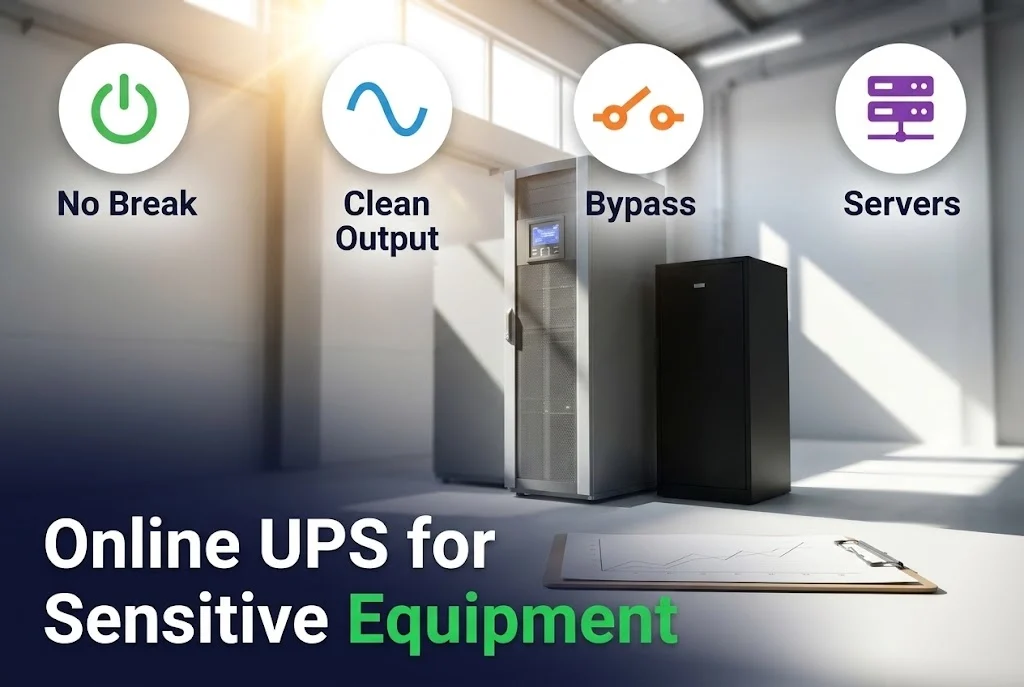
An online UPS is the choice when the equipment cannot tolerate even a tiny break in power or a poor supply. It converts the incoming power to DC and back to clean AC all the time, so the equipment always runs from the UPS’s own output and never sees the raw mains.
Because the battery is always connected, there is no switching time when the supply fails.
Key takeaways
- The output is clean and steady whatever the input does.
- There is no transfer time when the supply fails.
- It costs more and wastes a little more energy than other types.
- It suits servers, medical and laboratory equipment and critical network equipment.
How double conversion works
A rectifier changes the incoming AC to DC, which charges the battery and feeds an inverter. The inverter makes new, clean AC for the equipment. If the supply fails, the battery simply supplies the DC, and the output continues without a break.
Why it gives better protection
- Voltage dips, rises and noise on the supply are removed.
- Frequency is steady, which helps some equipment and generators.
- There is no transfer time when the supply fails.
- The UPS often has a bypass path that takes over if the UPS itself fails.
The trade-offs
Double conversion loses a little energy as heat, so an online UPS uses more power than a line-interactive one and needs good ventilation. It also costs more. For ordinary office equipment a line-interactive UPS is often enough.
Planning the installation
- Add up the load and choose the rating with a margin.
- Decide the backup time and size the batteries for it, see battery configuration.
- Provide a cool, clean room with enough ventilation.
- Plan the bypass and the input and output protection with the electrician.
When to call us
If your equipment is critical, our engineers can size an online UPS and plan its installation. Use the quote page, see our commercial UPS solutions, or look at the UPS systems we supply.
Leave a comment