
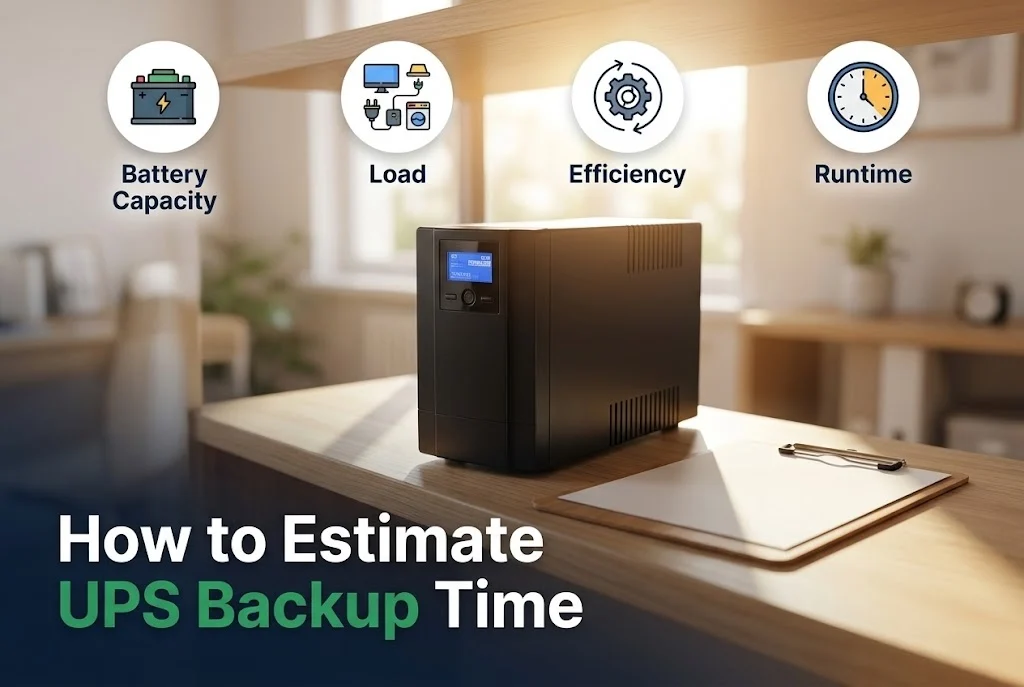
"How long will the UPS run?" is the most common question after a power cut. The honest answer is that it depends on the battery, the load and the age. You can estimate it with a few steps, then confirm it with the manufacturer's runtime chart.
Key takeaways
- Runtime depends on the stored energy in the battery and the power drawn by the load.
- Batteries give less energy when discharged quickly, so a heavy load gives less runtime than simple arithmetic suggests.
- Use the manufacturer's runtime chart for the final answer, and expect less as the batteries age.
- More runtime means more or larger batteries, or external battery cabinets.
1. The basic arithmetic
Energy (Wh) is the battery voltage times its capacity in amp-hours. A UPS with a 48 V bank of 7 Ah has about 336 Wh. The inverter loses about 10 per cent. If the load is 300 W, the rough runtime is 336 × 0.9 ÷ 300, about one hour, but real runtime is shorter, as the next section explains.
2. Why fast discharge gives less
A battery's rated capacity is usually quoted for a slow discharge, such as ten hours. Discharged in 15 minutes it gives much less. For example, the datasheet for the Narada Eos-2000 cell lists 2000 Ah at the 10-hour rate, 1500 Ah at the 3-hour rate and 1100 Ah at the 1-hour rate. The same battery gives roughly half the capacity in one hour that it does in ten. UPS runtimes in minutes are therefore far lower than a calculation from rated Ah.
3. Use the runtime chart
Manufacturers publish runtime charts or tables for each UPS and battery option, showing minutes against load. Use these for the final figure. They assume new batteries at room temperature.
4. Factors that shorten the time
- Ageing batteries; see when to replace a UPS or solar battery.
- High temperature or low temperature.
- Loads that are higher than you estimated.
- A battery that has not been fully charged after an earlier outage.
5. How to get a longer runtime
For more minutes, add external battery cabinets, if the UPS supports them, or choose a UPS with a larger charger and battery pack. Many sites combine a UPS (for seconds and minutes) with a generator or a solar and battery system for longer outages. Read home backup: UPS or solar hybrid.
6. Set the right expectation
For most offices, a UPS gives enough time to save work and shut down safely, or to let a generator start. Plan on that, not on running the office for hours.
Next step
Tell us your load and the time you need, and we will propose the batteries or battery cabinets; use the quotation form.
Leave a comment