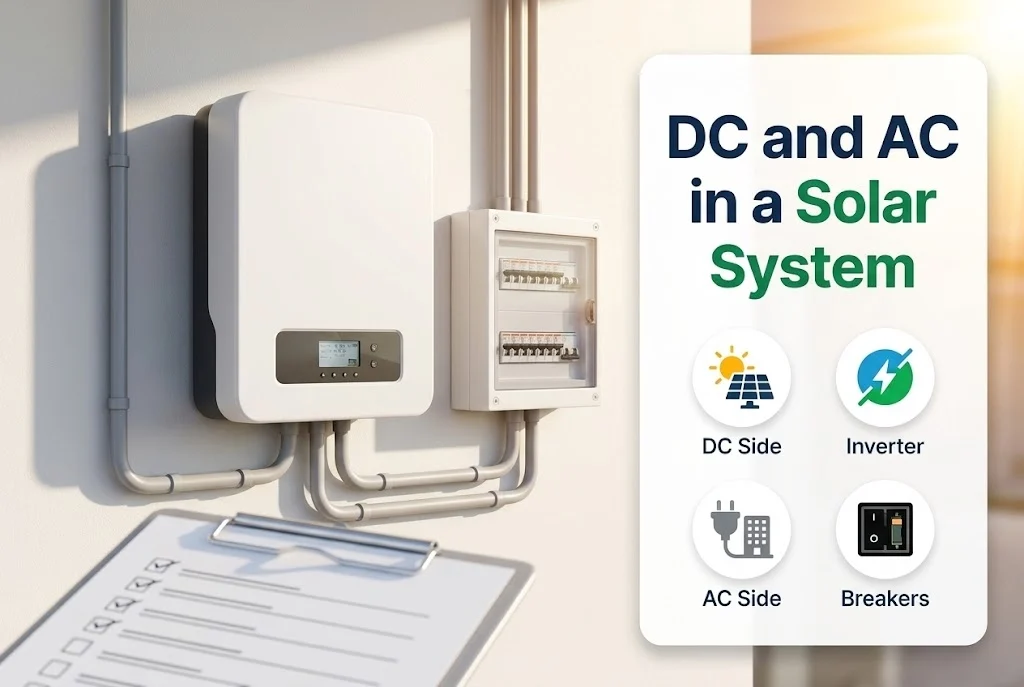
In a solar system, power changes form on its way from the roof to your sockets. The first part carries direct current (DC) and the second part carries alternating current (AC). The two need different cables, switches and care, and mixing them up is a common source of faults and danger.
Key takeaways
- DC runs from the panels to the inverter; AC runs from the inverter to the electrical board.
- DC needs DC-rated switches and fuses, because a DC arc does not go out by itself the way an AC arc can.
- Use solar-rated DC cable outdoors and correct AC cable for the load.
- Label both sides clearly so anyone working on the system knows what is live.
1. The DC side
The DC side starts at the panels and ends at the inverter input. Voltage here can be several hundred volts in a string, and it is present whenever there is light, even if the inverter is off. That is why the DC side must be wired with care and should never be opened casually.
2. The AC side
After the inverter the power is AC at the normal supply voltage and frequency (in Pakistan, 230 V single-phase or 400 V three-phase at 50 Hz). The AC side joins the main electrical board through a breaker. It follows the same wiring rules as any other circuit in the building, with correct cable size, protection and earthing.
3. Why DC protection is different
An AC current passes through zero many times a second, which helps a switch put out an arc. DC does not, so an arc can keep burning. For this reason, isolators, breakers and fuses on the DC side must be rated for DC and for the string voltage. A normal AC breaker is not a safe substitute.
4. Cables
DC cables on the roof sit in sun, heat and rain for decades, so they are made of UV-resistant, double-insulated material. AC cables are chosen for current, distance and voltage drop. If a cable is too thin it heats up and wastes power, and it is a fire risk. See also solar cables and protection devices.
5. Practical checks
- DC cables are solar-rated, tied up neatly and kept off sharp edges and hot surfaces.
- Connectors are the same make and fully pushed in; mixing makes can cause heating.
- DC isolator and AC breaker are labelled and easy to reach.
- The system is earthed correctly; see solar earthing and lightning protection.
Next step
If you are not sure how your system was wired, our technicians can inspect it. Contact us through the contact page or see our maintenance service.
Leave a comment